
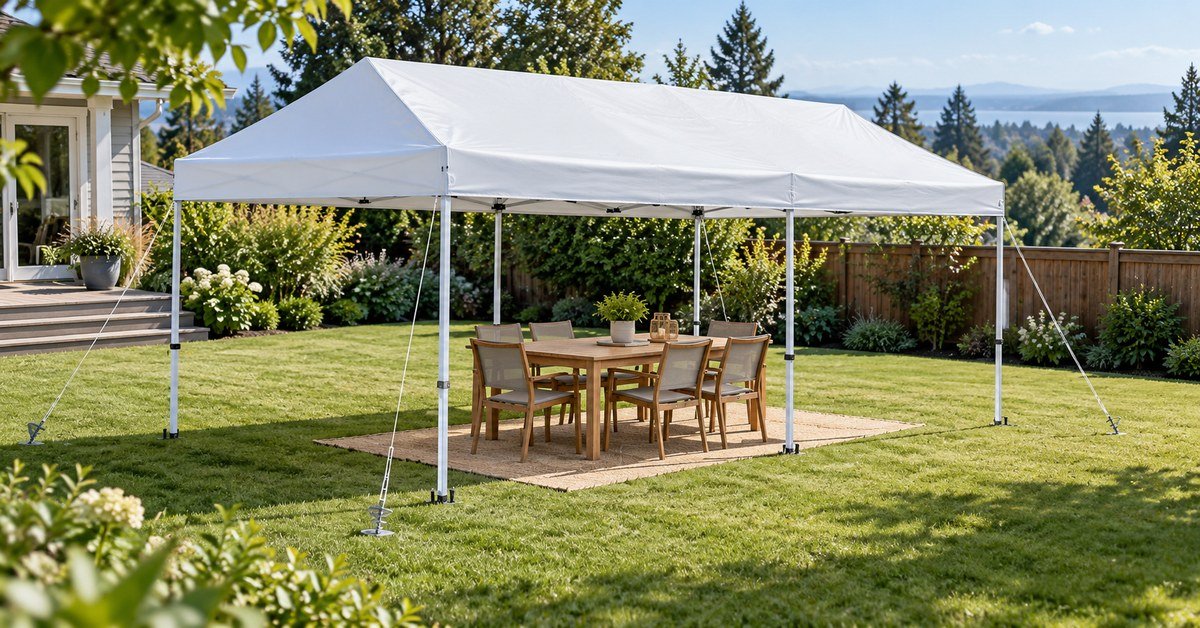
A canopy tent can cover a dining area, market booth, or garden seating spot. The right size depends on what must fit underneath and what space remains around it. Measure both before comparing frame styles or fabrics.
A roof’s advertised footprint does not describe the usable area once tables, chairs, equipment, and entrances are in place. A few measurements can prevent a tent that blocks a door or leaves no clear route.
Start with the surface, then sketch the layout you expect to use. Include anchors and sidewalls in the plan because they occupy space beyond the roof edges.
This guide compares common canopy types, sizes, materials, accessories, setup, and care.
Jump to a specific section in this article
What Is a Canopy Tent and What Is It Used For
A canopy tent is a temporary shelter with a raised roof supported by a portable frame. Many models have open sides, while others accept removable walls. The roof provides shade and some protection from light rain.
People use canopies for patios, markets, tailgates, and outdoor gatherings. The best fit depends on the activity and surface.
An open canopy keeps access easy from several directions. Walls add privacy or a wind break, but can reduce airflow.
A canopy tent is not a storm shelter or a substitute for a permanent roof. Fabric, frame, and anchoring limits vary by model. Read the manual before using one in changing weather.
For a small booth, room for a table may matter more than guest capacity. For dining, chair pullback and walking lanes use extra space.
A patio plan should include door swings and paths to the house. A market plan should include display depth and customer access.
Check the shade footprint at the hours you expect to use it. The sun’s angle can move shade beyond the roof outline.
Canopies can cover patio seating, market booths, event gatherings, or vehicles and equipment. On patios, plan for chair movement and door swings around existing furniture. For booths, include display depth, stock storage, and customer access. Event layouts need guest routes and anchoring space; vehicle shade needs height and roof-length checks.
Types of Canopy Tents: Pop-Up, Frame, and Event Styles
A pop-up canopy uses a folding scissor frame that expands beneath a fabric top. It suits temporary setups when packed size and quick assembly matter. Check the folded length and lifting weight before buying.
A traditional frame tent uses poles or a modular frame assembled on site. Its sections can cover larger footprints, though setup usually takes more steps.
Event canopies range from portable party shelters to modular commercial systems. Rental structures may require crew installation and venue-approved anchoring.
A hard-sided gazebo is a different kind of structure. Its heavier roof and fixed frame change installation, cost, and maintenance needs.
Choose by setup frequency, transport, and the space available for storage. A heavier frame may be practical if it stays near the setup location. Frequent solo transport may favor a lighter model.
A folding frame needs room to unfold without hitting a wall or vehicle. Assembly instructions should name the number of people required.
Ask whether walls, connectors, and replacement parts match the exact model. Similar product names can hide different frame systems.
| Style | Typical setup | Useful when | Check first |
|---|---|---|---|
| Pop-up | Folding frame opens as a unit | You transport and reset it often | Packed dimensions, weight, and parts |
| Frame tent | Sections assemble on site | A larger or reconfigurable footprint is needed | Assembly steps and frame compatibility |
| Event system | Modular components or crew setup | The event needs a planned, larger shelter | Venue rules, permits, and anchoring requirements |
| Fixed gazebo | Permanent or semi-permanent installation | A consistent location matters | Site permission, foundation, and local requirements |
How to Choose the Right Canopy Tent Size for Your Needs
Measure the usable ground area before choosing a roof size. Leave room for each leg, anchor, and route around the shelter.
List the objects that need cover and measure their footprints. Include chairs pulled out from tables, not only the table dimensions. Add coolers, display bins, and mobility aids to the plan.
Mark doors, gates, grills, stairs, and utility access on a simple plan. These areas need to stay clear during use. Mark where people enter and leave the covered area.
A canopy tent fits only when its full setup footprint works on site. Compare the roof size and leg footprint with the clear area before ordering.
For a booth, leave space for a person to stand behind the table. For a lounge, test the route between seats before adding sidewalls.
Turn the sketch ninety degrees to test a second orientation. A longer layout may fit better beside a fence or patio edge.
Measure overhead clearance under branches, eaves, and cables. The peak height and side clearance are separate measurements.
- Site rectangle: Record clear length and width so the legs and anchors fit within the usable area.
- Furniture zone: Include item footprints and movement space because occupied area exceeds the tabletop or equipment base.
- Access path: Note doors, gates, stairs, and routes to prevent blocked circulation.
- Overhead clearance: Record the lowest obstruction and canopy height to identify placement limits.
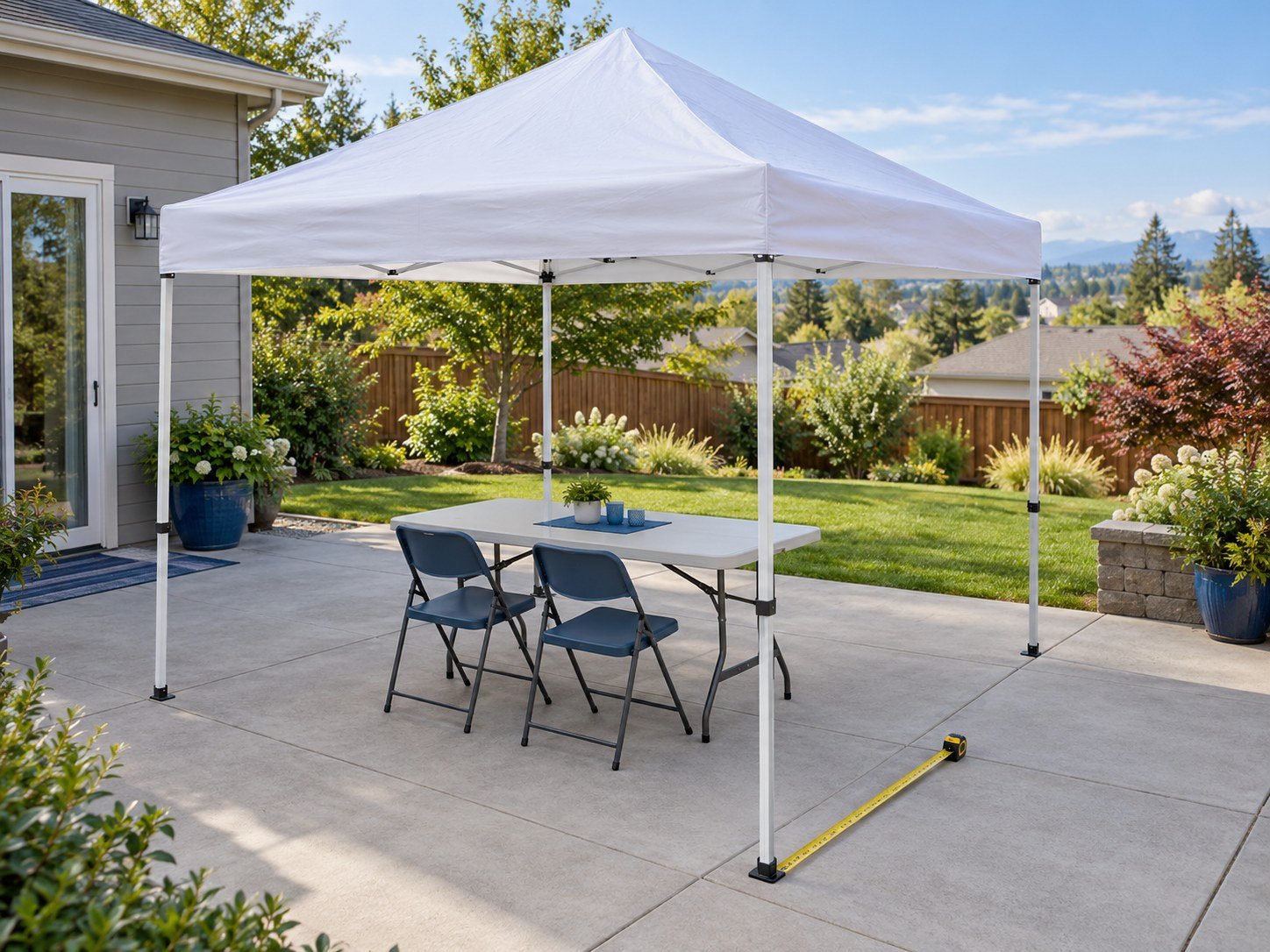
Canopy footprint fit planner
Use the measured outside leg-to-leg footprint. Clearance is added on every side; this rectangle check does not assess anchors, doors, slope, overhead space, or weather.
Canopy Tent Size Chart: Matching Dimensions to Guest Count
Canopy dimensions describe length by width, usually in feet. Multiply those measurements to estimate the roof’s nominal area. Some brands measure fabric edges differently from leg centers.
A 10 by 10 roof covers 100 square feet on paper. Legs, furniture, and circulation reduce usable floor area.
Guest count changes with table style and layout. A standing reception uses space differently from seated dining.
The chart shows footprint area rather than a guaranteed capacity. Use it to compare sizes, then sketch your layout. Capacity charts are estimates, not seating guarantees.
A 10 by 20 canopy gives a long zone for tables or a booth row. A square 20 by 20 footprint can support a more central layout.
Smaller 5 by 5 and 6 by 6 models can cover a compact station. They leave little room for furniture beside the user.
For shade, also consider time of day and sun direction. Roof area and shade area can differ as the sun moves.
| Nominal size | Roof area | Planning use | Capacity note |
|---|---|---|---|
| 5 × 5 ft | 25 sq ft | Compact station or small item cover | Too small for most table layouts |
| 8 × 8 ft | 64 sq ft | Small seating or a narrow booth | Check clearances around all four legs |
| 10 × 10 ft | 100 sq ft | Single booth or modest seating plan | Furniture and aisles reduce usable area |
| 10 × 15 ft | 150 sq ft | Longer serving or display zone | Confirm the length fits the site |
| 10 × 20 ft | 200 sq ft | Long table row or larger covered zone | Layout determines practical guest count |
| 20 × 20 ft | 400 sq ft | Broad gathering or event layout | May require a modular event structure |
| 20 × 30 ft | 600 sq ft | Large event footprint | Check installation rules and anchoring |
| 20 × 40 ft | 800 sq ft | Extended event or vendor area | Plan exits, crew setup, and local requirements |
Interactive size-area chart
Select a size button or bar to compare its calculated nominal roof area. The 20 × 60 ft example is calculated from its dimensions.
10 × 10 ft: 100 sq ft
Canopy Tent Frame Materials: Steel vs Aluminum
Steel and aluminum frames differ in weight, finish, and construction. The alloy or tube design matters as much as the material name. Compare published weights for the exact frame size.
Steel often weighs more for a comparable frame. That extra weight can make carrying and setup harder.
Aluminum frames are commonly chosen when lower carry weight matters. Check the manufacturer’s stated dimensions and connector design.
Neither material label proves wind performance or service life. Compare frame details, joint quality, corrosion protection, and the manual. Ask for full specifications before comparing models.
Tube diameter alone does not describe the whole frame. Wall thickness, bracing, and connections affect how parts work together.
Annotated canopy frame diagram
The diagram shows the canopy cover, frame joints, cross braces, legs, and foot plates discussed above. Use it to identify points to compare on a specific frame. Check that model’s manual because connections differ and the illustration does not indicate a wind rating.
Look for replacement parts before a hinge or foot breaks. A repairable frame may reduce waste after routine wear.
Compare frame weight with the roof fabric and accessories. The package weight determines whether one person can move it safely.
| Frame choice | Potential advantage | Trade-off to verify |
|---|---|---|
| Steel | Often offers a heavier, substantial feel | Total carry weight and finish condition |
| Aluminum | Often reduces frame weight | Tube design, joints, bracing, and replacement parts |
| Either material | Can be built in multiple frame grades | Published model-specific limits and warranty terms |
Steel canopy tent frame details
Steel is worth considering when the frame will be moved infrequently. The added weight can be inconvenient for repeated carrying. Compare the total packed weight with your storage route.
Inspect the finish for chips, exposed edges, and water traps. Store the frame dry to limit corrosion at damaged areas.
Check whether the legs telescope smoothly and lock fully. A bent tube or seized joint can prevent safe setup.
Read the exact product manual before adding walls or accessories. Added panels can change how the frame handles wind.
Aluminum canopy tent frame details
Aluminum can make transport easier when the canopy travels to events. Confirm its assembled and packed weights from the manufacturer.
Inspect connectors for looseness, cracks, and wear. A light frame still needs the specified anchors.
Compare the frame warranty and replacement parts across models. Ask how the manufacturer defines covered frame damage. Confirm which parts remain available.
Choose the frame by carrying needs and repair access. Do not use material alone as a structural rating.
Best Canopy Tent Fabrics and Waterproofing Options
Canopy tops commonly use coated synthetic fabrics, but the fiber and coating vary. Read the model label rather than relying on a generic fabric name. Labels alone do not establish a water rating.
Polyester tops can balance packability and everyday shade use. The coating, seams, and care instructions influence performance.
Polyethylene covers are often used on budget or utility shelters. Compare thickness claims and seam construction across exact models.
Vinyl-coated fabrics may suit heavier duty use. They can add bulk and weight when packed. Seam construction can matter as much as the textile itself.
A water-resistant label describes resistance under stated conditions. It does not guarantee protection during prolonged rain or pooling.
Look for care guidance on cleaning, drying, and storage. Abrasive cleaners can damage a surface coating.
Do not assume flame resistance from a color or material. Event venues may require a current label or certificate.
| Cover type | Common consideration | Questions for the seller |
|---|---|---|
| Polyester | Coating and seam construction vary | What water or sun rating applies to this exact model? |
| Polyethylene | Often used on utility shelters | How are seams finished and replacement tops obtained? |
| Vinyl-coated fabric | Can be heavier and bulkier | What are the packed weight and cleaning instructions? |
| Any coated cover | Performance depends on the finished product | Is the rating documented for the model and size? |
Canopy Tent Sidewalls, Weights, and Accessories Worth Adding
Accessories can improve shade, privacy, storage, or stability. Buy parts listed for the exact canopy model. Compatibility and site rules determine which pieces are useful.
Sidewalls block low sun and provide a visual boundary. They also catch wind and can limit airflow.
Anchors must match the surface and the manufacturer’s instructions. Venue rules may require specific weights or stake types.
A storage bag protects the fabric and helps keep small parts together. Replacement feet and connectors can extend service life. Put heavy components away from paths and exits.
Lighting should be designed for outdoor use and kept away from fabric. Keep cords out of walkways and away from water.
Gutters can connect neighboring roofs when the system supports them. They add more fabric and connection points to inspect.
Separate useful accessories from decorative extras. Prioritize the items needed for the site, weather plan, and setup.
| Accessory | Useful for | Check before use |
|---|---|---|
| Sidewall | Low sun, privacy, or display backdrop | Wind exposure, airflow, and attachment points |
| Weights or stakes | Anchoring to a suitable surface | Model manual, venue rules, and ground conditions |
| Storage bag | Transport and parts organization | Packed dimensions and zipper capacity |
| Replacement parts | Repair after wear or damage | Exact model number and compatible generation |
| Lighting | Evening visibility | Outdoor rating, heat, cords, and power source |
How to Set Up and Anchor a Canopy Tent Safely
Choose level ground clear of overhead hazards and vehicle routes. Check for buried utilities before driving stakes. Level ground helps the frame sit evenly.
Ask the venue about anchoring rules before arrival. Hard surfaces may require approved weights rather than stakes.
Follow the model manual for assembly and anchor placement. Use the specified number and type of anchors.
Keep people clear while the frame opens and locks. Stop if a joint binds or the frame looks bent. Finish raising the roof before adding load.
Secure every leg before loading tables or adding walls. Confirm that straps cannot become trip hazards.
Watch forecasts during outdoor use and plan where guests will go. A canopy does not protect people from lightning.
Move people to the planned shelter when thunder or severe weather approaches. The National Weather Service lightning guidance advises moving to a substantial enclosed building or hard-topped vehicle when thunder threatens.
| Setup stage | Action | Pause if |
|---|---|---|
| Site | Check slope, overhead clearance, and access routes | A hazard or blocked exit is present |
| Assembly | Open and lock the frame as the manual shows | A joint binds or a part is damaged |
| Anchoring | Secure every leg with approved hardware | The surface or anchor method is unsuitable |
| Weather | Monitor alerts and use the preplanned shelter | Thunder, severe weather, or unsafe wind approaches |
Canopy Tent Prices and Budget Ranges by Size and Quality
A canopy budget includes more than the roof and frame. Anchors, walls, shipping, storage, and replacement parts add to the purchase. Include delivery and tax in the total you compare.
Small consumer pop-ups usually sit in the lower price band. Larger footprints and more durable frames raise the total.
Commercial or event systems occupy a higher budget tier. They may require paid delivery, crew setup, or venue approval.
Compare complete packages with the same dimensions and included parts. A low base price can exclude necessary anchors or walls.
Ask whether the cover and frame are sold separately. Check the replacement cost before treating a bargain as a long-term saving. Ask whether tops remain available for that frame.
For frequent transport, include a cart or storage space in the budget. Carrying weight can affect the practical cost of ownership.
Prices change by market and season. Request current written quotes for the exact size, fabric, frame, shipping, and accessories.
How to Care for, Clean, and Store Your Canopy Tent
Inspect the frame, fasteners, feet, and fabric before each setup. Replace damaged pieces before use. A damaged leg can make the frame uneven.
Brush away loose dirt before cleaning the cover. Follow the manufacturer’s cleaner and rinse instructions.
Let fabric dry fully before placing it in a bag. Damp storage can cause mildew and odor. Dry the fabric in open air before folding.
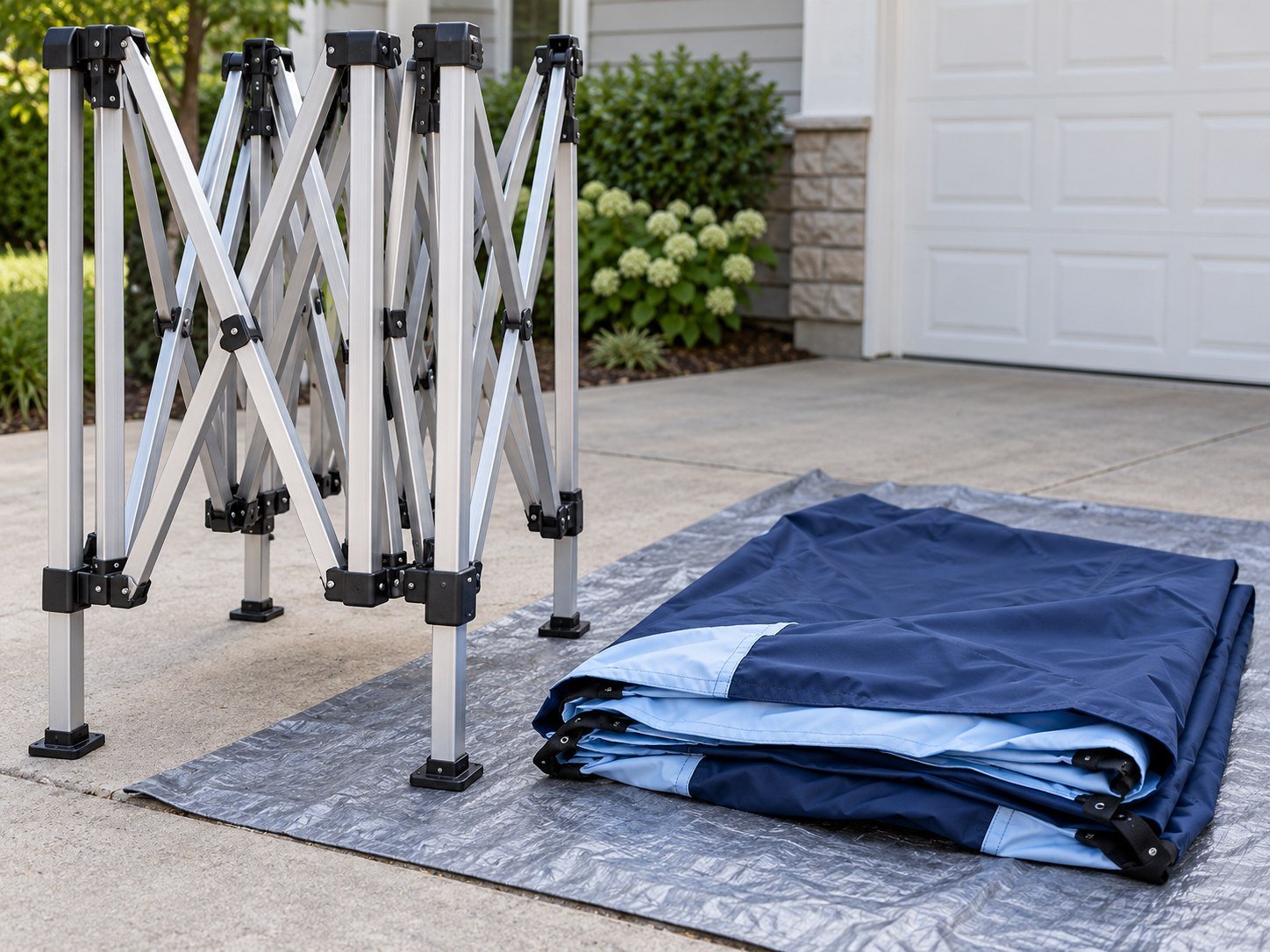
Fold the top without trapping sharp frame edges. Keep small pins and connectors in a labeled pouch.
Store the packed canopy in a dry place away from pests. Avoid stacking heavy objects on fabric or hinges.
Check seams and stitching after heavy use. Early repairs can prevent a small tear from spreading.
A short inspection before every event is easier than repairing damage on site. Choose storage that can accommodate the packed frame’s weight and dimensions.
| When | Care task | What to check |
|---|---|---|
| Before setup | Inspect frame and cover | Bent parts, torn seams, loose fasteners |
| After use | Brush dirt and clean as directed | Coating wear and clogged drainage points |
| Before packing | Dry every fabric surface | No damp folds or trapped debris |
| During storage | Keep parts dry and organized | No crushing load, pests, or missing connectors |
Frequently Asked Questions about Canopy Tents
What size canopy tent should I choose for a patio?
Measure the usable patio rectangle and the furniture you plan to cover. Include chair movement and access to doors. Note any rails or walls that restrict placement.
Compare both canopy orientations against the clear area. Leave room for legs, anchors, and a walking route.
Choose the smallest roof that covers the layout without blocking circulation. A larger size can shade more area but may crowd the patio.
How many people fit under a 10×10 canopy tent?
There is no fixed guest count for every 10 by 10 canopy. Tables, chairs, serving equipment, and aisle space change the layout. Manufacturer limits may also apply.
A standing group uses the footprint differently from seated dining. Sketch the actual furniture before estimating capacity.
Ask the venue about occupancy and exit rules for public events. The canopy’s floor area alone is not an approval.
Is a 10×10 canopy tent large enough for a table?
It can fit a table when its dimensions and position leave room for the legs, chairs, and movement. A large table or dining layout may use most of the interior. A smaller table or one-sided seating can leave more clearance. Measure the table and test the plan before buying.
Can I leave a pop-up canopy tent outside overnight?
Follow the manual’s guidance for unattended use and overnight weather. Many portable canopies are intended for temporary setups. Check the frame and top after each exposure.
Wind, rain, and changing conditions can strain fabric and frame. Take it down when the forecast or manufacturer instructions call for removal.
Are canopy tents waterproof?
Some covers resist water, but the exact rating depends on the finished model. Check seams, coating, and manufacturer conditions. Seam sealing can differ between sizes and generations.
A water-resistant label does not guarantee performance in prolonged rain. Pooling water can stretch fabric or overload the frame.
Use a canopy only for the conditions allowed by its manual. Move people and equipment indoors when the weather becomes unsafe.
Never treat a portable canopy as storm shelter.
What canopy tent anchoring works on concrete or grass?
The surface determines which anchor method is possible. Stakes need suitable ground, while pavement may require approved weights. Check local rules before the event begins.
Use the anchor type and weight specified for the exact model. Event venues can set stricter requirements.
Secure every leg and check the connections during use. Do not rely on improvised objects or one anchor point.
Do canopy tent sidewalls help in wind?
Sidewalls can block low sun and drifting rain. They also present more fabric to moving air. Check each sidewall’s attachment method in the product manual.
Use walls only as the manufacturer allows and remove them when conditions require it. Do not assume a sidewall improves stability.
Keep an open exit and avoid enclosing cooking equipment. Follow the model’s ventilation and fire guidance.
What should I check before buying a canopy tent?
Confirm the roof dimensions, leg footprint, peak height, and packed size. Compare them with your site sketch. Check the model’s allowed setup conditions.
Check frame weight, cover material, included anchors, and compatible replacement parts. Read the warranty for its exact exclusions.
Ask whether the product includes sidewalls or sells them separately. Confirm return shipping and assembly requirements.
Save the manual with the order.
What to Remember About a Canopy Tent
Choose a canopy tent by matching its full footprint to the ground, furniture, access routes, and weather plan. A measured sketch is more useful than a guest count that ignores tables and movement.
For occasional use, a portable pop-up may be the simplest fit when its packed weight and anchors suit the job. Larger gatherings or repeated events may call for a different frame system, venue checks, or a rental crew.
The right purchase is the one that covers the intended layout while leaving clear circulation and a safe path indoors when conditions change.