

A 10×10 canopy tent gives market vendors a familiar square space to organize. Crowded aisles leave little room for guessing where a stall should fit. Its compact footprint supports a counter, stock, and a defined customer approach. Organizer rules and measured layouts determine whether that starting space works.
A square pitch measures ten feet along each side. That rectangle contains 100 square feet before tables and visitors occupy it.
Market rules, anchoring requirements, and actual roof coverage vary by location and model. Comparing them matters more than relying on a simple size label. The right canopy also needs to travel, assemble, and remain stable.
This guide explains the market logic behind the format and its everyday limitations. It uses named product specifications and real organizer policies where figures matter. The planning tools are examples, not substitutes for event rules or manufacturer instructions.
Jump to a specific section on this article
Why Choose a 10×10 Canopy Tent for Outdoor Events?
A 10×10 canopy tent creates a clear outdoor workspace without demanding a large site. Its square footprint suits displays, check-in points, demonstrations, and simple gathering areas. Four corners also make the allotted ground space easy to visualize.
The nominal dimensions describe a ten-foot width and a ten-foot length. Multiplying those dimensions gives a ground footprint of 100 square feet. That area is a layout starting point, not a permitted occupancy figure. Shelves, tables, people, and canopy legs all compete for room.
Event coordinators can arrange repeated square pitches along an aisle. Vendors can reuse familiar layouts when markets allocate matching spaces. Visitors also recognize a compact, open-sided stall from a distance.
The roof supplies overhead shade, although moving sunlight can reach under its edges. Sidewalls may reduce direct exposure but also change airflow and wind loading. A 10×10 footprint cannot predict a specific model’s actual shaded area. Check the roof dimensions before relying on a size label alone.
For small events, the standard shape keeps placement straightforward. Larger gatherings may need multiple independently approved shelters or another structure. Joining units does not automatically create a compliant event installation.
The best size still depends on the activity inside. A sales counter needs different clearances than rows of seated guests. Plan for access before deciding how much merchandise to display.
Choosing a canopy tent starts with the roof, frame, and complete installation footprint. A booth that needs several simultaneous activities may require a wider structure. For routine market vending, a correctly fitted ten-foot square remains a practical starting point.
What ten feet in each direction means
Why Is 10×10 a Common Standard for Vendors and Markets?
Ten-by-ten pitches appear in many organized outdoor market rules. Tukwila Farmers Market, for example, assigns vendors 10-by-10-foot market spaces. That standardization helps organizers place repeated stalls beside consistent customer aisles. It also makes measuring stall boundaries easier during setup.
The dimension is common, but it is not universal. Other markets may allocate different indoor or specialty outdoor spaces. Always read the latest rules for the event you booked.
Market policies regulate more than the roof’s nominal measurements. Some specify the tent footprint, displayed merchandise, and permissible signage locations. Others require particular ballast, fabric documentation, or setup procedures. A vendor should check every relevant condition before arrival.
A ten-foot shelter does not grant permission for outside displays. Tables and racks may need to stay completely inside the pitch. Guy lines can also violate boundaries or obstruct nearby walkways.
Ballast rules belong to the event where you are trading. Tukwila requires at least twenty-five pounds attached to each canopy leg. That is one market’s minimum and does not approve other sites.
Market organizers can reject equipment that fails their written conditions. The same tent might qualify at one market and fail another. Checking first prevents a wasted journey and rushed onsite changes.
Treat the published event handbook as your controlling reference. Keep proof of any required canopy fabric certification with your supplies. Use manufacturer instructions as an additional requirement, not a substitute for market rules.
| Organizer or authority | Documented rule | What vendors should verify |
|---|---|---|
| Tukwila Farmers Market | Assigned vendor space is 10 ft x 10 ft. | Fit fixtures and restraints within the allotted boundary. |
| Tukwila canopy rule | Minimum 25 lb attached to each canopy leg. | Check the exact attachment and current event conditions. |
| Prince George’s County market application | Identify tent dimensions and provide required flame documentation. | Confirm the permits and documents for the local event. |
How Does a 10×10 Canopy Fit a Standard Market Stall?
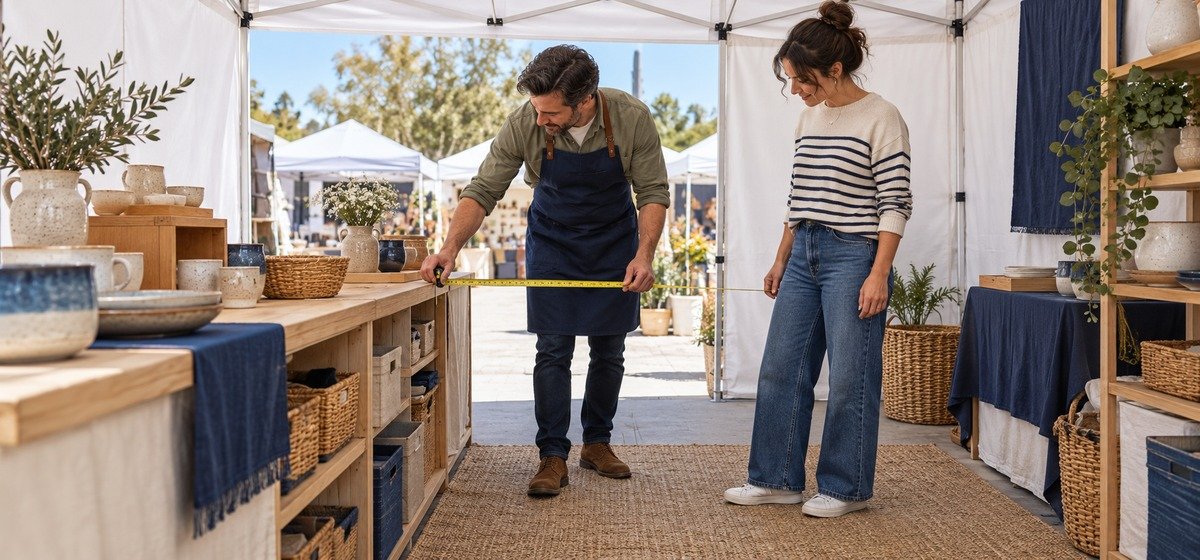
A nominal ten-foot square contains 100 square feet of ground. You cannot allocate all that area to tables and merchandise. People must still enter, browse, pay, and turn comfortably. Canopy legs and secured ballast also occupy parts of the perimeter.
Start by marking the four approved pitch boundaries. Measure the actual canopy feet instead of assuming the roof label matches them. Leave no fixtures extending into an organizer’s required circulation route.
A counter measuring six by two feet leaves eight feet behind its depth. Its six-foot length leaves four feet across the pitch before other fixtures. Orienting the counter changes where those remaining strips fall within the booth.
For a practical example, place two tables along adjoining walls. A five-foot table and a four-foot table share limited corner space. Check their actual depths and allow room behind the sales point.
A central display may slow traffic through a shallow booth. Heavy stock should stay stable and away from entry routes. Put water, electrical cables, and packaging where people will not trip. Keep all required exits and accessible routes unobstructed.
Sketch a plan before you transport equipment to market. Confirm that every crate and ballast weight fits inside the allowed rectangle. Test the layout using real table and display measurements.
Quoted canopy dimensions can describe a roof, base, or clear interior. Mark those measurements separately before drawing tables and restraints. A square-foot total cannot reveal a narrow opening beside a projecting foot.
Area budget
Reserve the equipment area before arranging people
Enter explicit numbers, including zero when a category is empty. Reserve separate, non-overlapping footprints only. This subtraction does not establish routes, accessibility, or permitted occupancy.
How Do Portability and Coverage Compare in 10×10 Canopies?
A market canopy needs useful cover without overwhelming the person carrying it. Two models can share ten-foot dimensions yet differ substantially in packed mass. Frame materials, truss geometry, and roof construction help explain those differences. Comparing the exact model is more useful than comparing size labels alone.
The E-Z UP Vantage 10×10 canopy, Royal Blue provides a named straight-leg canopy example. The EAGLE PEAK 10×10 Slant Leg canopy, Blue has an eight-foot-square top within its ten-foot-square base. Their nominal size labels therefore describe different roof areas.
These examples compare roof dimensions on the same nominal ground footprint. Both retailer listings identify complete canopies with carrying equipment. Their accessory sets differ, so package weights need separate verification. Neither roof area nor listed weight establishes weather performance.
A ten-foot-square roof provides 100 square feet of horizontal plan area. An eight-foot-square roof provides sixty-four square feet within that same base. That is thirty-six square feet less overhead cover before sun angle changes shade.
Commercial frames may emphasize repairable components and repeated setup. Lighter recreational frames can prioritize compact transport and easy deployment. Neither category alone proves that a model will survive stronger weather.
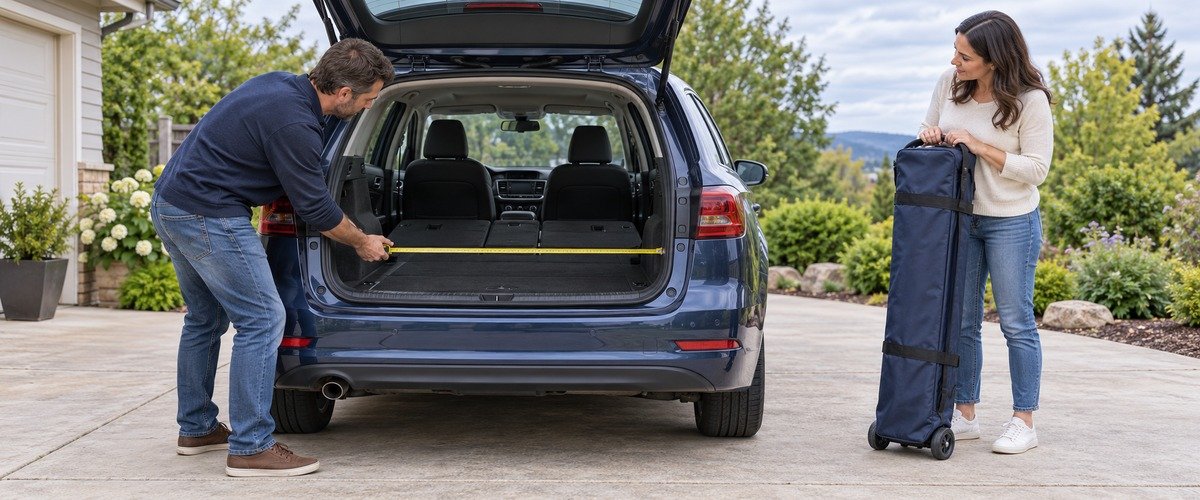
Read the folded length before choosing a car or storage space. Measure your vehicle opening, not only the trunk’s interior length. Reserve room for tables, ballast, and the remaining market equipment.
A pop-up canopy's frame and roof serve different measurement questions. The ground footprint determines where its feet can stand. The roof dimensions determine the horizontal area available for cover.
Frame Weight, Materials, and Transport Practicality
Frame material affects the weight you lift and the joints you maintain. The named straight-leg example uses a powder-coated steel frame. Aluminum frames can also suit repeated market use when their construction fits the task. Compare complete assemblies with their actual bags and accessories.
A wheeled carrying bag reduces the distance you must carry equipment. It cannot remove stairs, curbs, or soft ground from your route. Check the bag wheels before moving onto uneven surfaces.
The packed length must pass through your vehicle’s actual opening. Bag handles, wheels, and rigid corners can change that fit. Measure the full packed unit before reserving space beside other equipment.
Inspect replacement-part availability before relying on a frame for repeated work. Keep joints free of grit when manufacturer instructions allow cleaning. Record the selected model so replacement components fit correctly.
Canopy Fabric Durability, Waterproofing, and UV Ratings
Fabric specifications describe separate properties that affect a roof in different ways. EAGLE PEAK specifies 150D fabric and UPF fifty-plus for its named slant-leg model. Those figures describe yarn mass and ultraviolet protection respectively.
A fabric’s denier describes yarn mass, not completed roof lifespan. Waterproof claims require careful attention to seams and testing conditions. UPF ratings address ultraviolet transmission, not wind resistance.
Water resistance also depends on seams and how the roof is installed. A fabric claim applies to the specified product and its documented configuration. Check any required fire certificate for the exact material supplied. Neither denier nor a flame certificate establishes a canopy’s service life.
Inspect roof tension, stitching, and attachment points before each event. Dry the fabric according to manufacturer guidance before long-term storage. Replace damaged material rather than masking structural wear with accessories.
Roof coverage comparison
One base size can hide different roof areas
All three examples have a nominal ten-foot-square base. Values describe horizontal roof plan area, before sun angle or obstructions change useful shade.
Select, hover over, or keyboard-focus a bar for its dimensions and calculation. Roof width x roof length gives plan area. These figures do not measure wind resistance, live shade, usable guest capacity, or packed mass.
How Easy Is a 10×10 Pop-Up Canopy to Set Up?
Fast deployment matters when vendors have limited unloading time. Some instant frames remain connected as they expand and lock. That reduces loose hardware, although it does not eliminate careful setup.
The CROWN SHADES CenterLok 10×10 canopy, Grid White uses a central hub to lock the frame. Its listing describes deployment by two people without tools. A central release can simplify the mechanism while still requiring a helper. Follow the instructions for the exact model and fitted accessories.
Before raising a frame, inspect ground conditions and overhead hazards. Position ballast and anchoring supplies where they will be needed. Keep shoppers away from moving trusses during deployment. Extend the roof without forcing bent or obstructed joints.
Secure the shelter immediately using the required anchoring method. Do not leave an unweighted frame standing while arranging merchandise. Confirm that every foot and brace is correctly seated.
Adjust the leg heights together as the instructions require. An uneven adjustment can stress joints and deform the canopy roof. Recheck clearances after all accessories are attached.
Practice your setup at home before your first booking. This exposes missing pieces before the market’s narrow unloading window. It also helps you organize a predictable packing order.
At closing, lower the roof before removing the last restraints. Keep equipment supervised until the frame is fully folded. Store dry materials away from sharp objects and crushing loads.
Five checks before opening the stall
This is a memory aid, not a substitute for the product manual or event safety inspection.
How Do Weather and Wind Affect 10×10 Canopies?
A 10×10 canopy is not an all-weather refuge. Even secured pop-up shelters can fail during severe gusts. Market wind limits and manufacturer instructions should control every decision.
Tukwila’s market requires twenty-five pounds attached to each canopy leg. Other events can impose different ballast, attachment, and shutdown conditions. Treat the written market policy and product manual as simultaneous requirements. A numerical minimum alone does not establish a safe installation.
Sidewalls can increase the surfaces that catch moving air. Extra ballast alone may not make that changed configuration safe. Follow the selected canopy’s approved sidewall and anchoring guidance.
An unobstructed path helps staff leave quickly during worsening conditions. Never obstruct emergency routes with weights, cables, or display stock. Give one person responsibility for watching weather alerts.
The National Weather Service advises clear thunderstorm response plans. Open canopies and tents do not provide lightning-safe shelter. Move people to substantial buildings or appropriate enclosed vehicles. Do not wait for rain before responding to thunder.
Water resistance does not make a roof suitable for pooled water. Roof tension and correct pitch help avoid some drainage problems. Lower or remove equipment when manufacturer limits are approached.
Treat wind ratings as test-specific claims rather than general operating permissions. Examine the test conditions and the full approved assembly. Local restrictions still apply even when marketing emphasizes stronger frames.
| Question | Practical response | Relevant authority |
|---|---|---|
| How much ballast? | Use the exact organizer and manufacturer requirement; there is no single universal number. | City of Tukwila canopy policy |
| When should the canopy come down? | Follow site-specific gust thresholds, warnings, and manufacturer operating limits. | Exact product manual and event policy |
| Is a tent safe in lightning? | No; seek a substantial building or an appropriate enclosed vehicle. | National Weather Service |
How Does a 10×10 Canopy Deliver Value Across Repeated Events?
A reusable canopy can reduce repeated setup decisions across similar events. Its value depends on performance, care, and how often vendors deploy it. Purchase price alone cannot establish a useful comparison.
Track setup time, transport burden, and replacement parts across events. These practical measurements reveal costs that a product label cannot express. A heavier professional frame may suit a frequent market routine. A lighter frame may work better for occasional short trips.
Expected service life should never be inferred from fabric denier. Warranty wording also differs from a measured durability study. Check exactly what a manufacturer covers before planning repairs.
For illustration, consider six events during a typical month. Saving ten minutes at each setup would recover one hour monthly. That is a hypothetical time calculation rather than product performance evidence. The interactive estimate below lets you enter your own figures.
Include cleaning and drying work in the routine you compare. Wet fabric often requires additional attention after a market closes. Neglect can make a convenient shelter harder to maintain.
Reliable spare parts can matter when an essential joint fails. Record a canopy’s exact model before ordering a replacement component. Store manuals and service contacts where staff can find them.
Assess repeated-event value without assuming the cheapest unit is best. Use recorded setup effort and maintenance needs across your real schedule. Choose the configuration that remains practical under your conditions.
Event routine
Calculate the time your own routine could recover
Use a whole number of events and your own measured or estimated minutes. The defaults are hypothetical and do not compare product setup speeds.
Where Else Can You Use a 10×10 Canopy Tent?
A ten-foot canopy works beyond produce and craft vending. Its compact square plan also supports event information points and product demonstrations. The same roof cannot suit every weather or capacity requirement.
At a tailgate, place food and seating with clear circulation paths. Sporting events may require additional pedestrian or vehicle separation. Check venue rules before installing stakes or other ground penetrations. Keep equipment away from active driving lanes.
Trade shows sometimes use an indoor ten-foot booth outline. An outdoor canopy may not be allowed within that indoor space. Ask the organizer about structure height, fire rules, and signage limits. A simple backdrop may be more appropriate than a full tent.
Community organizers can use the space for registration or handouts. Tables can divide a small booth into work and visitor areas. Test the queue length against the site’s circulation rules.
Craft displays benefit from a predictable perimeter for hanging elements. Fragile merchandise requires stable racks and protection from wind. Samples or food sales may trigger additional permits and hygiene requirements.
An open market canopy differs from an enclosed camping tent in its enclosure and intended use. A vendor roof leaves the sides open unless approved panels are fitted. Overnight sleeping needs a shelter designed for that purpose and its expected conditions.
Always match the structure to the activity rather than its popularity. Another shelter style may handle complex requirements more effectively. The ten-foot square is a useful format, not a universal answer.
Measured layout examples
Four uses inside the same ten-foot square
All drawings use the same scale. Fixture dimensions and the three-foot strip are illustrative inputs, not approved aisle or accessibility dimensions. Actual feet, ballast, chair movement, entrances, and event requirements need a complete measured plan.
How Can You Customize and Brand a 10×10 Market Canopy?
A 10×10 canopy can serve as a recognizable market storefront. Strong visual identity helps visitors recognize a stall from across an aisle. Branding must still fit the tent and organizer’s display rules.
A printed valance can show the business name without occupying table space. Choose legible lettering that remains readable at normal walking distances. Use high contrast between the fabric and any printed type. Keep essential warnings and manufacturer labels visible.
A rear backdrop can frame merchandise and reduce visual clutter. It may also act as a wind-catching wall when installed. Confirm the selected frame supports that accessory combination. Take down graphics when conditions exceed permitted operating limits.
Avoid signs that hang into neighboring pitches or walkways. Secure display fixtures without making the canopy a hanging load frame. Review the manufacturer’s attachment guidance before adding weight overhead.
For repeated markets, a consistent front counter improves recognition. Place product names and directions near the point of decision. Keep any affiliate or sponsor messages distinct from safety notices.
A longer 10×20 footprint can separate service from a display when the booked pitch allows it. Wider graphics still need compatible attachment points and sufficient clearance. Select printed fabric only after confirming its fit on the chosen frame.
Photograph the finished stall from the customer aisle for review. Check whether products remain visible beneath your graphics and signs. Adjust presentation without obstructing access or weakening anchoring.
Annotated storefront concept
Keep branding visible without hiding the sales area
Which Accessories and Sidewalls Work Best With a 10×10 Canopy?
Accessories can turn an open shelter into a more useful market workstation. The right choices depend on the frame’s compatible hardware and event rules. Buying universal-looking panels without checking model compatibility can waste effort. Always identify the full product model before selecting an accessory.
The Eurmax USA 10×10 four-wall canopy, White illustrates a product supplied with removable zippered panels. Panels can help manage low sun and visual separation. Their use still depends on permitted openings and the exact anchoring arrangement.
Weight bags should attach according to manufacturer and organizer instructions. Keep ballast clear of trips, sharp edges, and busy customer routes. Never assume nearby tents can share a single unsecured weight. Inspect straps and attachment points before the canopy rises.
Use lighting designed for the permitted event power setup. Route cords away from pedestrians using approved protective methods. Confirm that signs and shelves do not overload trusses.
Choose a wheeled transport bag that fits the folded frame. Replacement tops must match attachment systems and roof geometry. Improvised fasteners can interfere with safe tension and drainage.
Ask whether the venue provides electricity before packing devices. Food service may require hygiene equipment and additional site permissions. Plan these items inside the actual approved footprint.
Match each accessory to the series, attachment points, and roof geometry. Those details determine whether a panel or replacement top can fit. Account for the changed openings and loads before using the installed combination.
Interactive accessory check
Choose the setup goal you need to assess
No accessory makes a canopy safe in lightning, extreme gusts, or conditions prohibited by its manual.
Frequently Asked Questions About 10×10 Canopy Tents
Why Is a 10×10 Canopy Tent So Common at Outdoor Markets?
A 10×10 canopy is common because many markets allocate square ten-foot vendor pitches. Organizers can line up repeated stalls with consistent boundaries and customer aisles. Vendors also gain a recognizable space for standard tables and displays. However, no single rule makes this dimension mandatory at every market.
Tukwila Farmers Market specifically describes 10-by-10-foot spaces in its vendor guidelines. Other events can offer different footprints or restrict canopy types entirely. Always confirm your market’s permitted dimensions before selecting equipment.
Do Most Farmers Markets and Craft Fairs Require a 10×10 Space?
Many markets use 10×10 spaces, including Tukwila’s outdoor vendor pitches. Tukwila requires vendors to use canopies within the allotted space. Other events can provide smaller indoor pitches or permit different arrangements. Confirm the booked event’s dimensions before choosing the shelter.
Check the assigned area, roof dimensions, and outward-projecting feet. Confirm whether merchandise, weights, and signs must stay inside the rectangle. Ask the organizer when an advertised stall dimension is unclear.
How Many Tables and People Fit Beneath a 10×10 Canopy?
For a practical market layout, start with one six-foot table and a clear customer approach. Two narrower tables may fit along adjacent sides with careful positioning. The roof covers a nominal 100-square-foot area, not a guaranteed safe occupancy. Actual space for people depends on table depth, merchandise, access, and event rules.
| Illustrative footprint allocation | Area |
|---|---|
| Nominal 10×10 square | 100 square feet |
| Two example tables, 2 ft × 6 ft each | 24 square feet total |
| Unallocated ground before ballast and people | 76 square feet |
Can One Person Set Up a 10×10 Pop-Up Canopy?
Some 10×10 canopy models are marketed for solo setup. The EAGLE PEAK 10×10 Slant Leg canopy, Blue is one such manufacturer-described example. Its PeakPush mechanism releases and locks at the center. CROWN SHADES describes two-person deployment for its named example. Follow the selected manual and postpone setup when conditions prevent controlled handling.
What Weight Should Anchor a 10×10 Market Canopy?
Tukwila’s market sets a minimum of twenty-five pounds attached to each canopy leg. For a four-leg frame, that minimum totals 100 pounds across the four legs. It is a local event requirement with specific attachment conditions. Your product manual and booked event can require a different arrangement.
A ten-foot shelter commonly has four corner legs needing independent restraint. Use approved attachments that cannot swing or create trip hazards. Sidewalls and worsening gusts may demand a different operating decision.
Check both the manufacturer’s manual and the written market policy. Follow the stricter applicable requirements and stop operating when conditions exceed limits. Never rely on ballast alone during severe weather warnings.
Can You Add Sidewalls to a Standard 10×10 Canopy Tent?
Yes, many 10×10 canopy models support compatible detachable sidewalls. Panels can help manage low sun, visual separation, or light rain exposure. Choose accessories for the exact manufacturer, series, and frame dimensions. A generic panel may have incompatible fasteners or unsafe tension.
Adding a wall changes the surfaces exposed to wind. Recheck ballast and operational restrictions before installing any enclosure. Close neither required access routes nor the paths people need to leave.
Use only configurations permitted by the product manual and organizer. Remove walls when the site requires an open-sided structure. Sidewalls never make an open canopy safe during lightning.
Accessory compatibility reminder
Questions to ask before fitting a sidewall
Match exact series and attachment points.
Check venue and organizer restrictions.
Reassess wind exposure and anchoring.
Keep accessible routes free from obstructions.
Will a 10×10 Canopy Fit in a Standard Car Trunk?
A folded 10×10 canopy fits only when its packed dimensions clear the vehicle opening. Measure the bag’s full length, width, and height with the frame inside. Check the narrow doorway as well as the cargo space beyond it. Wheels and handles must pass through without forcing the bag against the car.
Measure the actual trunk opening rather than only its interior depth. Allow room for a wheeled bag, loose accessories, and ballast. Check that loaded items do not block safe driving visibility.
Read the exact model’s folded measurements before buying. Compare them with the vehicle you will use repeatedly. Loading weight and lift height matter alongside package length.
How Do Straight-Leg and Slant-Leg 10×10 Canopies Differ?
A straight-leg frame can place its roof corners above the feet. The named slant-leg example has a ten-foot-square base and eight-foot-square roof. That yields sixty-four square feet of nominal roof area. A full ten-foot-square roof provides 100 square feet for comparison. Confirm the exact roof and base dimensions before booking equipment into a ten-foot pitch.
Check whether the canopy feet extend beyond the permitted pitch. Measure both the shelter and any attached restraints before setup. Choose the geometry that fits the market and your display layout.
Do Vendors Need a Permit to Install a 10×10 Canopy?
Permit requirements depend on the jurisdiction, venue, event activity, and canopy setup. Some public markets handle site approvals centrally through their organizers. Others request fire documentation, approved layouts, or separate operating permits. Selling food or using generators can trigger additional requirements.
Prince George’s County asks market applicants to identify tent sizes and structures. Its published process also requests flame documentation when tents are used. Check the relevant authority for the event you are attending.
Ask the event organizer which approvals are already covered. Keep copies of required certificates and permits with your market supplies. Recheck conditions when using sidewalls, heat sources, or multiple structures.
Never assume a small canopy is automatically exempt from local rules.
Ready to Use a 10×10 Canopy Tent?
A 10×10 canopy tent works well when its complete installation fits the booked square pitch. Its familiar shape helps vendors repeat a workable display arrangement. Choose a full ten-foot roof when the event requires that much overhead cover.
Place the counter where its depth leaves a usable staff route. Keep stock, secured ballast, and every fixture within the permitted boundary. Check the arrangement with people occupying the working positions.
Use the chosen model’s manual alongside the event’s written conditions. Confirm the packed unit can reach the pitch in your vehicle. A measured layout and compatible equipment make this size practical for routine market work.