
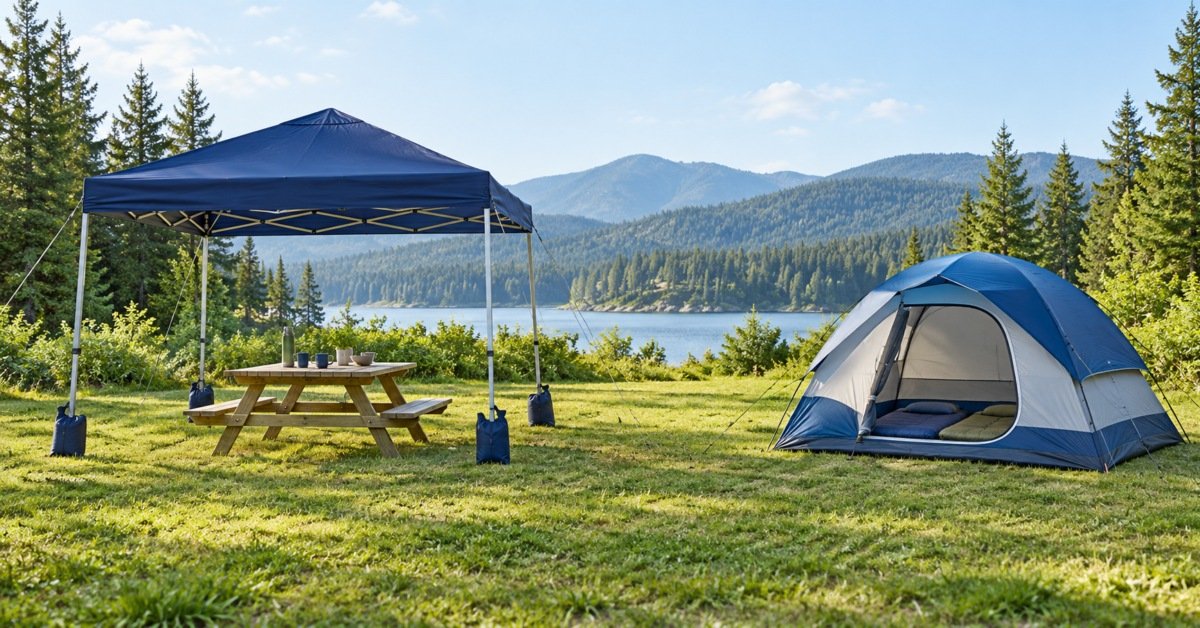
Canopy vs tent becomes a practical choice when rain, bedtime, and a crowded picnic share the same weekend. A canopy usually provides an open roof for daytime activities. A camping tent usually adds an enclosed body and integrated floor for sleeping. Both need suitable ground, correct installation, and conditions within their instructions.
Those general differences become clearer when you compare specific products. A folding canopy can weigh more than a small sleeping tent, while an instant cabin tent can match its bulk.
This comparison uses manufacturer specifications for two canopies and two camping tents. Setup claims describe manufacturer-stated deployment and do not include every installation task. Roof area and floor area stay separately labeled throughout the comparisons.
For parents, the useful question is where children will eat, change, rest, and sleep. Choose the enclosure and layout that support those activities before comparing headline capacity numbers. As an Amazon Associate, Shelter Set earns from qualifying purchases.
Jump to a specific section on this article
What Is a Canopy and What Is It Used For?
A canopy is a roofed shelter supported by a frame or poles. Most portable pop-up models leave their sides open for access and airflow. The ground beneath them remains exposed unless you add separate flooring.
That arrangement suits a serving table, market counter, or temporary outdoor workspace. People can approach from several sides without passing through a doorway. A covered activity also remains connected to the surrounding yard or event. Privacy and insect exclusion usually require additional compatible panels.
The CROWN SHADES RM100H is a straight-leg canopy with a ten-by-ten-foot footprint. Its nominal roof rectangle provides one hundred square feet of overhead coverage. That figure does not include an enclosed sleeping floor.
Shelter Set / practical comparison
Open activity space or enclosed sleeping space?
Concept plans explain the enclosure difference; they are not measured product layouts.
Approach from several directions; plan the actual ground and restraint space.
Plan bedding, equipment, ventilation and a clear route through the doorway.
A roof can shade a table while leaving low sunlight entering from one side. Rain can also reach furniture when wind carries it beneath the open edges. Adding a wall changes that exposure without sealing the ground beneath the shelter. Choose the entire arrangement for your activity, including required anchors and access.
Product names sometimes include the word tent even when the sides remain open. An instant canopy tent can therefore be an ordinary folding shade shelter. The actual construction explains its use more reliably than the shopping label.
Understanding canopy construction helps separate optional accessories from the basic roof and frame. Check what the selected package actually includes before budgeting for an enclosure. A photograph with walls can show a different bundle from the one selected.
Large frame canopies and pole-supported event shelters belong to a more complicated installation category. They may need professional assembly, engineering, permits, and site-specific restraint arrangements. The small portable examples here do not establish rules for those larger structures.
What Is a Tent and What Is It Used For?
A camping tent creates an enclosed space intended for sleeping and storing personal gear. The body commonly includes a sewn-in floor, closable door, and ventilation openings. A separate rainfly or single-wall construction provides the model’s intended rain protection. These features distinguish sleeping accommodation from a roof over an outdoor activity.
Coleman’s Sundome 4-Person Camping Tent, Navy 2207036 has a nine-by-seven-foot floor, totaling sixty-three square feet. Its listed center height is four feet eleven inches. That central measurement already rules out upright standing for many adults.
An enclosed floor gives sleeping pads and bedding a defined interior boundary. Furniture and luggage still consume that same measured space. Sloping walls can reduce usable room above the floor’s edges. Measure your bedding arrangement instead of assuming a stated person count guarantees spare storage.
The CORE 9 Person Instant Cabin Tent, model 40008 provides a fourteen-by-nine-foot floor. The manufacturer rates it for nine sleepers but describes four people plus gear as more comfortable. Its taller cabin shape serves a different task from the smaller dome.
A tub-style floor raises its perimeter to reduce water entering around the base. It does not make a poor drainage site suitable for sleeping. Choose level ground where runoff will not collect beneath the tent.
For parents, an enclosed tent can separate bedtime from a busy campsite. Zipped doors and mesh help manage exposure when used as instructed. They do not replace supervision or create a secure enclosure for unattended children.
The word tent also covers large event structures without integrated sleeping floors. A marquee therefore needs a different comparison from a compact camping tent. Always identify the intended activity before using the category name to make a decision.
What Is the Main Difference Between a Canopy and a Tent?
The main difference is the space each structure is designed to create. An open canopy supports an activity underneath an overhead roof. A camping tent encloses people and equipment within a defined sleeping interior. That difference affects circulation, flooring, privacy, handling, and how you use the covered area.
The interactive comparison keeps two actual canopies beside two actual camping tents. Select a model on each side to change its specifications. Each figure retains its meaning, including whether an area describes a roof or floor.
The EAGLE PEAK E64EPT-02-AZ Blue 10×10 Slant Leg Pop Up Canopy has an eight-by-eight-foot roof. Its sixty-four-square-foot roof is smaller than its hundred-square-foot base rectangle. That difference shows why canopy dimensions need checking at both roof and ground level.
Four researched models
Canopy versus camping tent: compare the real specifications
Choose one of two canopies and one of two tents to compare the features that affect your setup.
CROWN SHADES: 36 lb, 100 ft² roof. Coleman: 9.1 lb, 63 ft² floor. Roof and floor area describe different functions.
Manufacturer figures checked 26 October 2026. Product weight excludes separate equipment. Use the Pricing buttons to check the selected retailer listing.
| Specification | Canopy: RM100H | Camping tent: Sundome 4 |
|---|---|---|
| Model | CROWN SHADES RM100H 10×10 | Coleman Sundome 4-Person Camping Tent, Navy 2207036 |
| Category | Canopy | Camping tent |
| Listed shelter weight | 36 lb | 9.1 lb |
| Area and its meaning | 100 ft² nominal roof; no sewn floor | 63 ft² enclosed floor |
| Ground / floor rectangle | 10 × 10 ft base | 9 × 7 ft floor |
| Peak / center height | 108 in peak | 59 in center |
| Integrated floor | No built-in floor | Integrated tub-style floor |
| Enclosure | Open sides; compatible accessories depend on package | Closable body, mesh ventilation, included rainfly |
| Supporting frame | Connected folding steel frame | Separate poles assembled through sleeves |
| Setup information | Webpage promotes solo use; linked manual starts with a partner | Pole assembly plus rainfly, staking and tensioning |
| Packed dimensions | Check the manual and supplied bag for this version | Packed size not clearly labeled in the checked listing |
| Pricing | Check latest pricing | Check latest pricing |
| Availability context | Selected package and availability can change | Manufacturer page showed a back-in-stock notification |
| Lightning refuge | Not a safe lightning refuge | Not a safe lightning refuge |
| Approved restraint system | Follow the exact model and site requirements | Follow the exact model and site requirements |
The Sundome’s sixty-three-square-foot floor is almost the same area as that smaller roof. One measurement describes enclosed floor space, while the other describes overhead cover. Similar numbers therefore do not mean the shelters perform the same job.
A canopy offers several open approaches to a service counter or table. A sleeping tent channels entry through its designed doorways. That trade-off matters when guests repeatedly carry plates or children move between activities. Large doors still need clear approaches, especially when bedding or furniture fills the interior.
Solid sidewalls narrow the distinction around privacy and sideways exposure. They do not automatically add a sealed floor or an approved sleeping configuration. Check the exact enclosure system before changing the intended use.
Neither category has a universal advantage in every row. Compare the feature that controls your activity before ranking price or size. Check the floor boundary and supporting frame before choosing accessories.
Walls, Floor and Enclosure Differences
Start at ground level when comparing an open canopy with a camping tent. The canopy’s legs support the roof without joining a sewn-in floor. The camping tent’s body normally connects to its own floor perimeter. That connection creates a defined interior for bedding and personal belongings.
Optional canopy panels may stop some sideways exposure or provide visual privacy. Mesh panels prioritize screening while retaining airflow through their openings. Neither accessory establishes that the base is sealed against runoff.
A groundsheet placed under a canopy remains a separate item. Secure its edges and check whether water can collect on it. It should not obstruct routes or replace a purpose-designed sleeping floor.
For changing clothes, check that the walls close properly around the actual activity. For sleeping, choose a model whose instructions permit the complete overnight configuration. Keep ventilation openings usable when privacy panels or a rainfly are fitted.
Frame, Fabric and Structure Differences
A folding canopy carries its roof on a linked frame with upright legs. A small dome tent bends separate poles into arches supporting its fabric body. An instant cabin tent uses another arrangement with poles already attached.
Frame materials alone do not establish the shelter’s wind resistance. Joints, geometry, fabric attachments, anchors, and configuration work together during use. Compare the whole product’s instructions rather than selecting steel or aluminum by name.
CROWN SHADES lists 150D roof fabric for the RM100H canopy. CORE lists 68D polyester and a 1200 mm water-resistance figure for its cabin tent. Denier concerns yarn mass, while the millimeter figure describes a water-pressure test. Those measurements answer different questions and cannot be converted into one durability score.
Eurmax’s Pro 10×10 Aluminum Pop Up Tent supplies an aluminum-frame example. Its manufacturer stocks spare parts, which matters when a joint needs replacement. Match the replacement to that exact model before attempting a repair.
Which Is Better for Weather Protection, a Canopy or a Tent?
For ordinary showers, an enclosed camping tent usually provides more complete coverage around sleeping gear. That advantage comes from its body, floor, rainfly, and correctly arranged ventilation. An open canopy can keep overhead drizzle off a table while its sides remain exposed. Neither statement establishes a safe storm rating for every model.
The CROWN SHADES RM100H 10×10 canopy listing describes its roof as water-resistant. The Coleman Sundome 4-Person Camping Tent lists a tub-style floor, welded corners, and protected seams. These features address different entry paths for water.
A manufacturer’s water-resistance number also needs its stated testing context. CORE’s 1200 mm fabric figure does not describe a complete shelter surviving any rainfall. Seams, openings, runoff, setup, wear, and exposure still affect real use. Do not treat a fabric number as a flood or storm guarantee.
Shelter Set / practical comparison
Compare the response to the actual conditions
Select the condition; comfort features do not establish a storm rating.
Open sides suit a table or counter; low sun can reach underneath. Check the roof rating and use appropriate sun protection.
An enclosed sleeping space can become uncomfortable in heat; keep intended ventilation open.
Choose for the activity and exposure. Neither shelter is a safe lightning refuge.
Wind creates another comparison that product weight alone cannot settle. Canopy sidewalls increase the exposed surface and can change installation requirements. Tents also need their specified stakes, guylines, and suitable site.
Neither a canopy nor a camping tent is a safe lightning refuge. The National Weather Service directs people toward a substantial building or enclosed hardtop vehicle. Plan that retreat before starting an outdoor gathering or overnight stay.
Heat and insects can make the enclosure decision less straightforward. Open sides permit easy circulation, while closable mesh helps manage insects. An enclosed tent needs its intended ventilation even when occupants want privacy.
Use the weather selector to separate ordinary comfort decisions from situations requiring retreat. It does not assign unverified wind limits or certify either structure. When conditions exceed the manual, move people first and follow the manufacturer’s shutdown guidance.
Canopy vs Tent Setup Time, Portability and Storage
The lighter shelter depends on the models being compared. CROWN SHADES lists the RM100H canopy at 36 lb. Coleman lists its navy Sundome four-person tent at 9.1 lb.
That makes the canopy 26.9 lb heavier in this particular comparison. It does not establish that every canopy weighs more than every tent. CORE’s larger instant cabin tent is listed at 37 lb. Here, the tent weighs one pound more than the canopy.
The weight chart switches between pounds and kilograms without mixing shipping and product weights. Use it to compare handling demands across the four named products. Add the separate weight of anchors, bedding, tables, and other necessary equipment. The shelter’s listed mass is only part of the load you transport.
Shelter Set / practical comparison
The tent can be lighter, or slightly heavier
Manufacturer-listed product weights, checked 26 October 2026; not the complete equipment load.
Vertical categories: named shelter models. Select, focus or hover over a bar for its exact figure.
Horizontal axis: manufacturer-listed product weight (lb)
Fast frame deployment does not mean the complete campsite is ready. CORE advertises setup in as little as two minutes for its instant cabin tent. Staking, tensioning, organizing gear, and checking the finished installation remain separate tasks.
The RM100H webpage promotes solo operation, but its linked manual starts with a partner. Follow the manual for your delivered version when marketing claims and instructions differ. Practice the sequence before an event makes a delay inconvenient.
Packed length also matters when loading a small vehicle or cupboard. The CORE 9 Person Instant Cabin Tent, model 40008, packs to 48 by 11 by 11 inches. The EAGLE PEAK E64EPT-02-AZ Blue 10×10 Slant Leg Pop Up Canopy’s bag measures 44.88 by 7.87 by 7.87 inches.
A portable canopy still needs a manageable route between vehicle, setup area, and dry storage. Measure narrow openings and the turn into your storage space. Choose equipment you can carry and control through the instructed setup.
When to Use a Canopy Tent for Events, Markets and Outdoor Shade
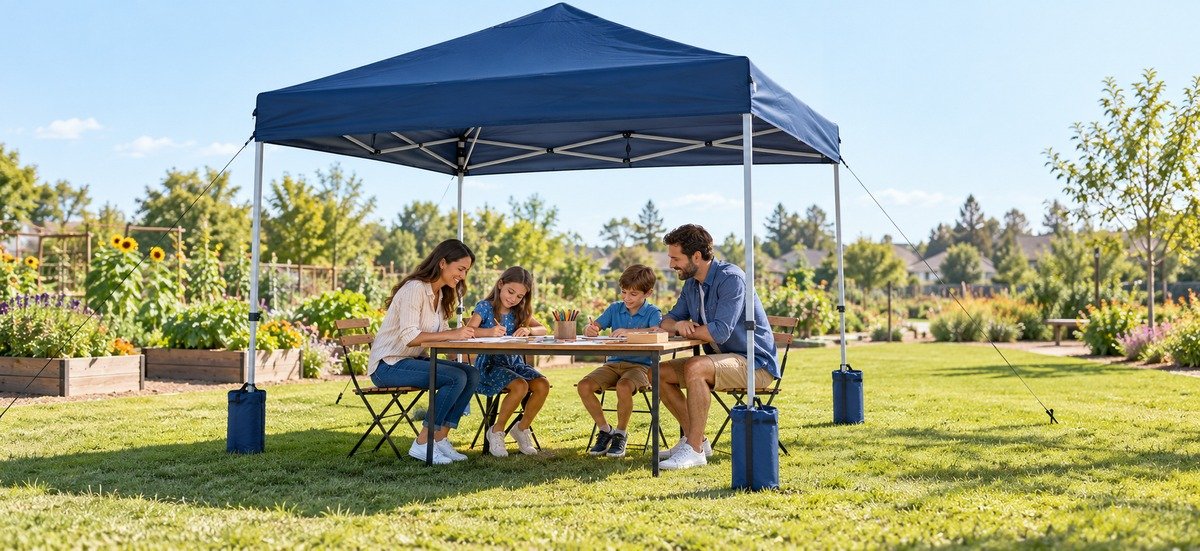
A canopy suits activities that need shade and frequent movement through the covered space. Examples include a market counter, a picnic table, or a supervised children’s craft station. The open perimeter helps adults approach the activity without entering a sleeping room.
Parents should start with the movement around chairs and bags. Leave enough room to reach children without crossing required anchors. Keep leg weights and guylines outside the normal play route. The roof does not provide containment, childcare, or protection from every weather condition.
A market stall also needs a service opening and separate space for stock. Some sellers use compatible walls at the back or sides. That configuration still needs approval under the canopy instructions and organizer’s rules.
A camping tent is usually awkward as a public serving booth. Its floor and doorway constrain the repeated movement of customers. Sloping walls can also interfere with upright displays or shelves. Choose an event structure designed for the activity when a simple portable canopy is insufficient.
Venue requirements can include approved anchors, fire documentation, and a defined pitch. The advertised roof size may omit the restraint space around the legs. Confirm the complete installation fits before booking the position.
For a backyard meal, furniture can become the controlling measurement. Mark chair positions with people getting up from the table. An empty ten-foot square can feel very different once guests and furniture occupy it.
Choose a canopy when the main job is open daytime cover. Choose an appropriate enclosed event structure when privacy or controlled access determines the activity. Keep sleeping accommodation as a separate decision when guests remain overnight.
When to Use a Tent for Camping, Shelter and Overnight Stays
A sleeping tent suits trips where people need an enclosed overnight space. Its floor, door, mesh, and rainfly are designed to work together. A separate canopy can complement that tent as a daytime dining area.
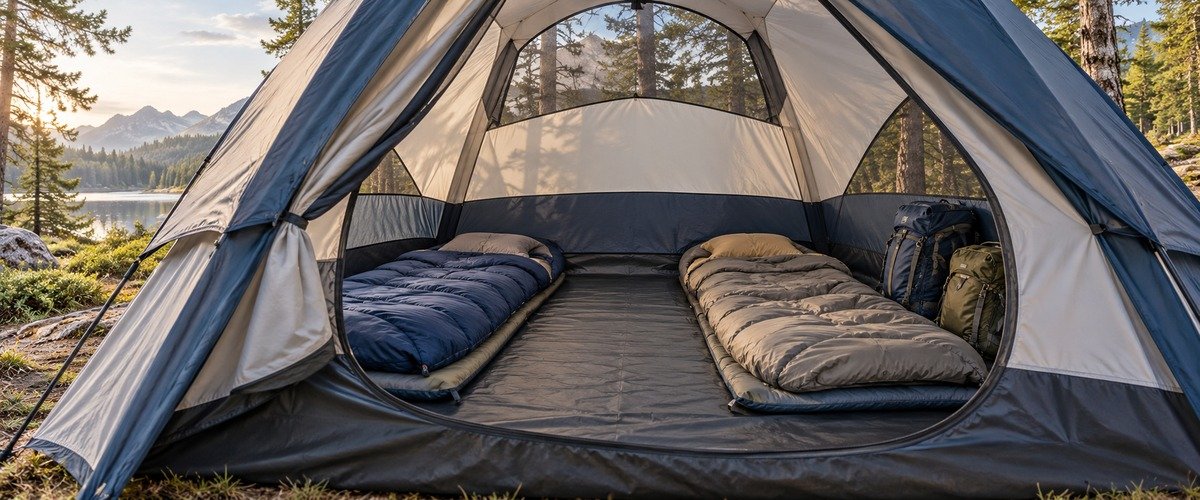
For a family, lay out the actual sleeping pads before selecting a person rating. Include overnight bags, spare clothing, and a clear route to the door. Keep equipment away from ventilation openings and fabric walls. A parent’s ability to reach a child matters more than filling every theoretical sleeping position.
The Coleman Sundome 4-Person Camping Tent has a smaller floor than the CORE 40008 Instant Cabin Tent. Compare usable height where you change clothes or help children. Peak height alone does not describe standing room across the entire floor.
Keep food preparation with heat outside ordinary fabric sleeping shelters. Follow stove, grill, campsite, and shelter instructions for separation. Fuel-burning appliances can introduce carbon monoxide danger as well as fire.
Choose a campsite where water will drain away from the sleeping area. A groundsheet should match the tent instructions and avoid collecting runoff. Keep footwear and sharp equipment from damaging the sewn floor. Check that guylines leave a visible route between tent and vehicle.
An open canopy does not become suitable sleeping accommodation merely because bedding fits underneath. Approved enclosure kits can change some models, but compatibility and use instructions still control. Do not improvise an overnight system from unrelated wall panels.
Neither shelter removes the need for an appropriate severe-weather retreat. Know where the family will go before conditions deteriorate. Treat the tent as camping equipment rather than a substitute for a substantial building.
How Long Do Canopies and Tents Last?
Durability depends on the exact fabric, frame, exposure, and repair options. Published fabric tests provide firmer comparisons than an unsupported promise of several seasons. Those tests describe a component under stated conditions, not the service life of an assembled shelter.
Mastertent reports 100,000 bends without UV exposure for its Pirontex 600D canopy fabric. Its Oxford 500D comparison records 20,000 bends under that same condition. The company identifies DIN EN ISO 32100 as the bending test. These are fabric bending results, not counts of opening and closing a canopy frame.
Mastertent also reports Pirontex lightfastness at grades 7-8 on an eight-point blue scale. Its Oxford 500D comparison ranges from 4.5 to 6.5 on that scale. The stated lightfastness method is DIN EN ISO 105-B02. A higher result indicates better resistance to color change in that test.
| Published fabric measure | Mastertent Pirontex 600D | Mastertent Oxford 500D |
|---|---|---|
| Bending test, without UV exposure (DIN EN ISO 32100) | 100,000 fabric bends | 20,000 fabric bends |
| Lightfastness (DIN EN ISO 105-B02; maximum grade 8) | Grade 7-8 | Grade 4.5-6.5 |
| Fabric construction | 600D: two 300D yarns | 500D Oxford weave |
| What the numbers describe | Specified fabric samples under the reported test conditions | Specified fabric samples under the reported test conditions |
| What they do not predict | Years of shelter service, frame opening cycles or safe wind limits | Years of shelter service, frame opening cycles or safe wind limits |
Eurmax specifies a 500D polyester roof for its Pro 10×10 Aluminum Pop Up Tent. That construction figure does not include a published years-to-failure result on the checked product page. Ask about compatible replacement roofs and frame parts when planning frequent market use.
E-Z UP Canada’s Pyramid 10×10 listing gives a three-year warranty. That is coverage under its terms, rather than evidence that every Pyramid lasts three years. Confirm the warranty that applies to your seller, country, and exact package.
Inspect folding-canopy sliders and locks, and check camping-tent floor seams, zippers, and pole connections. Dry fabric completely before storage, including damp folds. REI’s tent-care guidance also advises limiting unnecessary ultraviolet exposure.
Daily market deployment and two annual camping trips create different wear and exposure. Keep sharp stakes separate from folded fabric and use the manufacturer’s cleaning method. Replace damaged components only with approved parts that restore the shelter’s intended function.
How to Choose Between a Canopy and a Tent
Start with the activity that would fail if the shelter lacked the right feature. For sleeping, prioritize the intended enclosure, floor, ventilation, and usable bedding layout. For a market counter, prioritize access, approved setup, and working room. For family meals, check furniture movement and the route around the anchors.
Next, compare the exact models against your measured site. Separate roof area, ground footprint, floor space, and restraint space. A larger advertised number can describe a different measurement from the one you need.
Then check handling, packed length, and the helpers available. A light dome tent may be easier to carry but offer limited standing height. An instant cabin tent can provide more headroom while remaining bulky. A folding canopy carries different accessories when the site requires additional restraints.
Shelter Set / practical comparison
Which category matches the job?
Choose the task first, then check the exact product against the site, occupants and conditions.
This selector matches an activity to planning checks. It does not approve an installation, assign occupancy, recommend a wind limit or certify sleeping suitability.
Use the decision tool to narrow the appropriate category. Its result identifies checks that still need resolving for the selected activity. It does not approve an installation, sleeping arrangement, or storm exposure.
The complete canopy planning process includes site measurements and the full equipment package. Apply those checks even when a retailer presents setup as a single-button operation. Use the manual for your delivered model when web descriptions disagree.
Compare complete cost only after confirming that the product fits its job. Include the accessories, storage, maintenance, and transport that your arrangement actually requires. Choose a professional supplier when an event exceeds your equipment or installation experience.
For an open table or service counter, a suitable canopy is usually the practical category. For enclosed overnight sleeping, choose a camping tent designed for the conditions and occupants. Use both when separate daytime cover and sleeping space genuinely serve different tasks.
Frequently Asked Questions about Canopy vs Tent
Is a gazebo the same as a canopy?
Gazebo and canopy overlap in retail language, so the name alone is insufficient. A gazebo may be a permanent roofed garden structure. It may also be a portable fabric shelter sold with mesh or walls. Check foundations, materials, intended exposure, and installation instructions for the exact product.
A folding gazebo-style shelter still needs its approved restraint arrangement. A permanent structure brings different planning and property requirements. Compare construction and intended use rather than expecting one consistent meaning from the label.
Is a marquee a canopy or a tent?
A marquee generally describes a larger event shelter rather than a camping tent. It may use poles, a clear-span frame, or another engineered support arrangement. Some installations have walls and temporary flooring, while others remain open. The term does not establish a built-in sleeping floor or a particular weather rating.
For an event, ask the supplier about installation, engineering, access, and required approvals. Confirm who provides restraints and monitors conditions during use. A compact pop-up comparison should not determine specifications for a large hired marquee.
Can you add sidewalls to a canopy to turn it into a tent?
Compatible sidewalls can enclose parts of a canopy and change privacy or exposure. They do not automatically create a sealed floor or an approved camping enclosure. Added walls can also change wind exposure and required restraint arrangements. Use only the combinations and overnight configurations permitted by the exact manufacturer’s instructions.
How many people can fit under a canopy?
Capacity depends on furniture, movement, exits, anchors, and the activity taking place. A roof-area calculation cannot establish a safe event occupancy. A sleeping-tent person rating also differs from the space guests need around tables. CORE explicitly distinguishes its nine-sleeper rating from a more comfortable four-person arrangement with gear. Ask the venue about occupancy requirements and test the actual furniture layout.
What size canopy do I need for a party or event?
Begin with the furniture and activity rather than choosing a generic people-per-square-foot number. Measure tables with chairs in their working positions. Include the counter, storage, and circulation needed at the same time. Then compare those measurements with the actual ground footprint and usable height.
The canopy size you select must also accommodate the approved installation around its feet. Keep guylines, weights, and necessary access within the permitted site. A nominal roof rectangle does not include every part of that arrangement.
The measurement record separates activity space from the shelter and its restraints. Take the completed measurements to the venue or supplier. For a large event, confirm the full layout with the responsible professionals.
| Record separately | What the measurement must include |
|---|---|
| Activity rectangle | Tables, chairs pulled out, people working, stock and equipment lids |
| Actual ground footprint | Outermost feet or projections, not just advertised roof dimensions |
| Required restraint zone | Approved weights, stakes, lines and access for connecting them |
| Circulation and exits | Walking routes, door movement, neighboring pitches and accessible access |
| Usable height | Entry edge, cross members and the height needed for the activity |
How do you anchor a canopy so the wind does not blow it away?
Use the exact model’s approved anchors, attachment points, and installation sequence. The surface and fitted walls can change what the permitted system requires. Follow any additional venue requirements before opening the shelter for use. A heavy object nearby provides no restraint without the specified connection.
Do not treat a bag’s filling capacity as the ballast required per leg. A complete weight-set total can also differ from the mass of each unit. Weigh filled equipment and confirm that the arrangement matches the manual.
Never remove required anchors simply because the pitch is narrow. Choose another site or arrangement when the complete installation cannot fit. Prioritize people and follow the shutdown plan when conditions exceed the shelter’s limits.
Do you need a permit to put up a canopy or tent at an event or market?
Permit requirements depend on location, structure, size, use, and event arrangements. Do not assume a small retail canopy automatically has approval for a public pitch. The venue may require documentation even when a particular permit threshold is not crossed. Ask the responsible local authority and organizer before committing to the event.
Seattle’s fire guidance, for example, distinguishes shelters with walls from shelters without walls. Its published table uses different area thresholds for those configurations. Assembly occupancy can introduce another permit requirement within that same table.
Those Seattle distinctions demonstrate why one nationwide size rule would be misleading. Check the current requirements where your event will actually take place. Record the responsible contact, approval requirements, and final permitted layout before setup.
Shelter Set / practical comparison
Record the requirements for the actual event
A published city example shows why wall configuration and occupancy matter alongside area.
The published fire-permit table includes a tent-permit threshold above 400 ft².
The corresponding tent-permit threshold is above 700 ft²; assembly occupancy can create separate requirements.
Seattle example only, checked 26 October 2026. Grouping and clearance rules also affect exceptions. Smaller sizes are not a blanket exemption from event, venue, assembly or other local requirements.
Can a canopy be used as a car shade or carport?
A temporary canopy can provide vehicle shade when its instructions allow that use. Measure the vehicle, open doors, roof accessories, entry height, and approach space. Keep the required anchors outside tire paths and walking routes. A short-term shade setup should not become unattended permanent vehicle storage. Choose a purpose-designed carport when ongoing outdoor exposure is the actual requirement.
Local rules and property permission may apply to that carport. A camping tent is not a practical substitute for vehicle clearance. Check the complete installation rather than selecting a roof solely by advertised width.
What is the difference between a pop-up canopy and a frame canopy?
A pop-up canopy opens through a connected folding frame. A sectional frame canopy uses separate members assembled into the roof support. Both arrangements still need their specified anchoring and installation sequence. The word pop-up describes deployment, rather than a guarantee of weather resistance.
Folded frame length matters when transporting a pop-up model. Sectional equipment can need more sorting and space for laying out parts. The exact design determines how those practical differences affect your setup.
Compare the manual’s helper requirements, packed dimensions, component count, and replacement support. Practice unfamiliar mechanisms before using the shelter for a busy event. Do not force damaged joints or substitute unrelated components to finish assembly.
Choose the complete system you can transport, install, supervise, and maintain as instructed.
Ready to Explore Canopies and Tents?
For canopy vs tent, choose the structure that creates the space your activity actually needs. A suitable canopy provides accessible daytime cover for tables, displays, and supervised gatherings. A camping tent provides the intended enclosed floor and body for overnight sleeping. Verify the exact model, complete installation, handling, and cost before buying either shelter.