
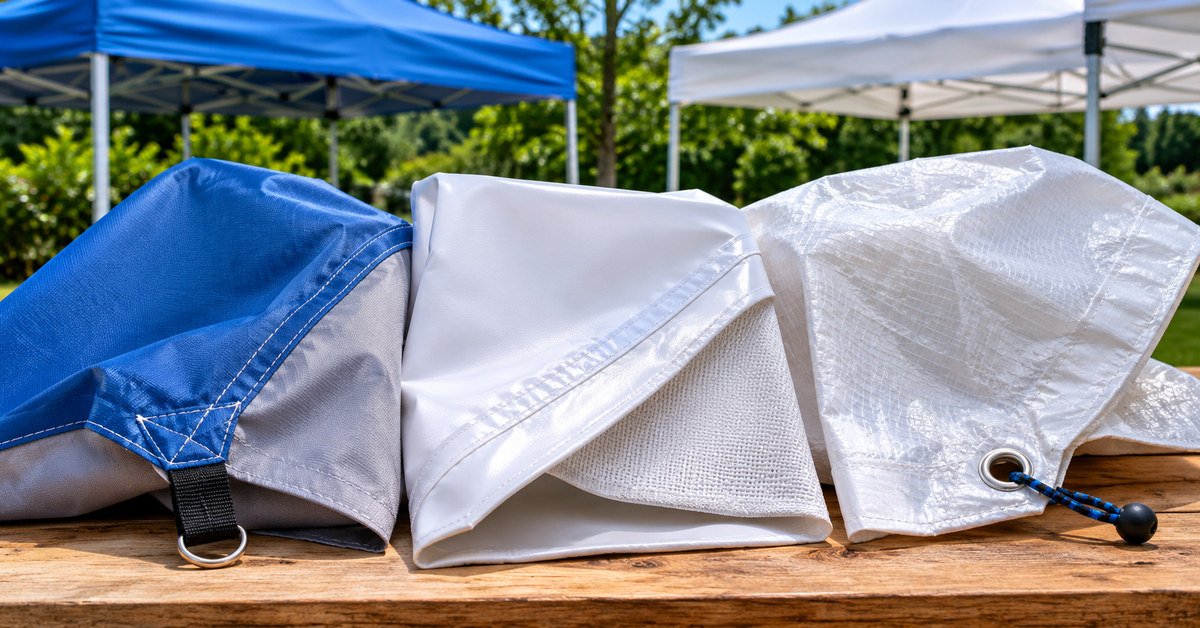
Choosing a canopy tent material starts with use: frequent pop-up packing, larger event installations, or seasonal utility coverage. Coated polyester is usually the most convenient option for repeatedly transported pop-up roofs. Reinforced PVC-coated fabric offers washable surfaces and welded-seam options for many larger event structures. Woven polyethylene usually serves dedicated utility shelters, with roof tension and fasteners matched to their frames.
Polyester describes a woven reinforcement, while vinyl often means PVC applied over polyester rather than a wholly separate textile. Polyethylene covers more often use woven plastic tapes laminated with protective film, giving them different folding and fastening characteristics.
None of these names alone tells you whether water can enter at a seam or corner. Finished-fabric tests, compatible roof geometry, and maintenance instructions determine the practical trade-offs that matter. Match the roof to the actual frame and exposure rather than ranking materials by one marketing adjective.
For weekly vendor use, focus on foldability, reinforced corners, and how quickly wet fabric can be dried. For longer setups, prioritize seam construction, ultraviolet aging evidence, and manufacturer anchoring requirements. Below, the three constructions are compared through concrete specifications and the decisions they support.
Jump to a specific section on this article
Decode Canopy Fabric Labels and Coating Terms
Polyester, vinyl, and polyethylene are not three equivalent grades on a single durability scale. Choose coated polyester for compact pop-up handling, PVC-coated reinforcement for specified event-tent panels, or woven polyethylene for compatible utility covers. Vinyl can actually be the coating on a polyester base cloth, so the names may overlap. The relevant comparison is the finished assembly’s behavior, not whichever polymer appears first in its marketing description.
Polyester yarn forms a woven textile, often finished with polyurethane or PVC for weather resistance. PVC-coated polyester combines a fabric reinforcement with a vinyl surface that can support compatible welded joints. Woven polyethylene combines plastic tapes with outer films, often fitted to frames using bungees.
Denier describes yarn mass along a specified length; it does not measure waterproofing or tear force. Grams per square meter measure sheet mass per area when the specification covers the completed coated textile. To compare different coatings, ask whether the quoted figure includes all layers rather than only the bare fabric.
A manufacturer may describe polyurethane as PU and polyvinyl chloride as PVC in a coating field. Neither abbreviation independently confirms whether exposed seams will resist driving rain. Before comparing labels, review how a typical canopy is assembled so roof and frame claims stay separate. Confirm whether a stated rating concerns the fabric sheet, the stitched roof, or the assembled shelter.
Check three things on the existing shelter before ordering a different roof material. Measure the outer leg spacing and peak shape, then photograph every fastening point. Finally, record the frame model, because a nominal ten-foot canopy dimension rarely establishes replacement-cover compatibility.
Assess Polyester Canopy Fabric for Portable Tents
For a market canopy erected weekly, woven polyester offers a useful balance of flexibility and workable packing volume. Its dense fabric surface can accept coatings, but those finishes change how the roof folds and cleans. Repeated sharp creasing can stress coatings even when the underlying yarns remain intact. A polyester roof is attractive when transport and manageable storage matter more than a permanently tensioned panel.
Polyurethane-coated polyester generally stays comparatively pliable for folding, subject to the exact finish and fabric weight. PVC-coated polyester can offer a more substantial wipe-clean surface, but heavier constructions may fold less compactly. Neither finish corrects poorly sealed stitched seams or a roof that ponds water under weak tension.
On the roof-only Eurmax USA 10×10 Pop Up Canopy Replacement Top (White), the advertised fabric is 500D polyester. That 500D figure identifies yarn size, not how many newtons of force its finished seams resist. The white 10×10 variant is listed as a replacement top without a frame. Check straight-leg fit and roof peak geometry before assuming its nominal footprint matches your existing shelter.
Users who frequently transport pop-up shelters benefit from practicing clean folds instead of compressing corners against frame joints. Damp fabric should be dried before packing to reduce staining and microbial growth on collected dirt. When planning repeated market setups, canopy size and frame choices also influence how much roof handling your team does.
Choose a polyester top when frequent folding is unavoidable and the coating, seams, and attachments meet your event needs. A denser yarn label alone should not outweigh a poor frame fit or unreinforced corner.
Understand Vinyl Canopy Fabric and PVC Coatings
Vinyl canopy fabric usually means a PVC-coated or PVC-laminated textile reinforced by woven polyester. The reinforcement resists pulling loads while outer polymer layers provide a smooth, washable weather surface. This construction commonly suits specified event panels that remain tensioned longer than a folding pop-up roof.
Coating applies liquid or paste-based PVC material directly onto the textile reinforcement. Lamination bonds preformed film layers to the fabric using heat or compatible adhesives. Both methods produce multilayer membranes, but their adhesion and repair procedures can differ. A seller saying vinyl roof without naming its reinforcement and joining method leaves two important performance questions unanswered.
PVC surfaces often clean with a soft brush, mild soap, and water when manufacturers permit those methods. Abrasive scrubbers can damage finishes, while strong solvents may attack the coating. Follow the fabric maker’s cleaning instructions rather than assuming every vinyl roof tolerates the same chemicals.
Many PVC-based panels can be heat or radio-frequency welded to make joined surfaces without rows of stitching holes. That manufacturing advantage matters especially on large event roofs with long, highly exposed seams. However, a poorly executed weld can still peel or separate under repeated tension. Inspect welded laps, corner patches, and edge webbing rather than inferring waterproofness from PVC alone.
Cold temperatures can stiffen particular PVC formulations, making abrupt folds at rigid hardware more damaging. Keep folding temperatures within the membrane manufacturer’s recommendations, especially after the material has aged outdoors.
For larger installed tents, PVC-coated polyester is worth prioritizing when documented welded joints and handling procedures suit the system.
Evaluate Woven Polyethylene Canopy Covers
Unlike coated polyester, woven polyethylene uses polyethylene tapes as the main reinforcing strands. Outer films are laminated to that weave, creating a lightweight sheet that can be fitted tightly over metal frames. Stabilizers may slow ultraviolet aging, but the exposed laminate still needs inspection for cracking and delamination. Unlike a generic hardware-store tarp, a fitted cover must match the canopy’s roof shape and attachment spacing.
ShelterLogic’s ShelterLogic MaxAP 10×20 Eight-Leg Canopy, Model 23522 (White) combines a triple-layer woven polyethylene cover with a steel frame. The manufacturer’s model sheet specifies a one-piece white cover, eight foot plates, and bungee fasteners. This is a complete 10×20-foot shelter kit, not a loose 10×20-foot sheet intended for arbitrary frames.
On the MaxAP family, ShelterLogic describes heat-welded polyethylene construction as part of its waterproofing approach. Welding avoids needle holes along those joints, while bungees secure the fitted edges under tension. Neither feature makes the structure suitable for conditions outside its stated temporary-shelter instructions.
For seasonal utility shelters, bungee fasteners keep the roof attached at the locations specified by the frame designer. Portable polyester tops often use corner pockets or hook-and-loop straps instead. Switching materials without matching those fittings changes the load path and can leave gaps or strained corners.
Folding polyethylene sharply along the same lines may create concentrated wear at repeated creases. Remove grit and dry the surface before storing the cover loosely whenever practical.
Choose woven polyethylene by verified cover construction and frame compatibility instead of assuming any tarp will fit a canopy.
Compare Canopy Material Weight and Packability
Fabric mass per unit area and finished cover weight answer different transport questions. For illustration, a 300 g/m² sheet covering 10 m² contains about 3 kg of sheet material before hems. A pitched roof uses more fabric than its ground footprint, so that arithmetic is not a canopy weight estimate.
To make a fair comparison, separate the roof from steel poles, anchors, bags, and packaging. ShelterLogic’s model 23522 literature reports 94 pounds for its packaged complete 10×20-foot kit. That value includes far more than the polyethylene roof and cannot be compared to a replacement-top weight. Ask for the bare cover’s mass or finished fabric density when fabric handling is the real concern.
Weight alone will not tell you how a coating behaves when folded into a storage bag. Flexible coated polyester tends to handle repeated folding better than very stiff PVC membranes of comparable design. For either material, broad folds and clean surfaces reduce concentrated wear around hard seams.
A weekly vendor may move a folded replacement roof alone, while a full utility shelter requires transporting its frame. Before comparing products, check canopy footprints and coverage areas against the room available in the vehicle. Check actual packed dimensions and total kit weights, not just the roof polymer. Repeated handling makes a properly fitted travel bag and a dry staging surface more useful than speculative weight labels.
A cover that folds into a smaller volume may still require a longer drying period after rain. Packing a damp laminate alongside steel joints traps moisture and can damage finishes or hardware. Choose transport gear around the full set, then fold the cover using its specific care instructions.
Assess Canopy Material Tear and Abrasion Resistance
Tear resistance concerns the force needed to extend an existing cut or notch through a test specimen. Abrasion resistance concerns surface wear from rubbing against rough objects or repeated contact. Neither metric can be inferred from denier alone, because constructions and test methods vary.
Construction often matters more than the name of the base polymer. Woven tapes, knitted reinforcement, ripstop grids, and coated scrims each distribute local loads differently. Fabric pulled across an exposed bolt can fail even when its central panel tests well. Inspect corners, roof peaks, and contact points where real installation stresses concentrate.
A tensile test loads an uncut specimen, whereas tear testing starts with a deliberate cut or notch. Results reported in newtons can be compared only when conditioning, specimen orientation, and the methods match. The tested panel still excludes corner patches and seams unless those parts are specifically included.
Repeated folding can abrade coatings along sharp creases and at hardware contact points. On a large cover, dragging one wet edge across gravel can damage an otherwise sound panel. Use a clean staging area and lift fabric rather than scraping it over concrete. Inspect the inside surface too because hidden frame contact can initiate holes.
Check whether the manufacturer provides repair procedures for the exact coating or laminate. A small compatible patch may be practical before damage reaches a heavily tensioned seam. When reinforcement threads are severed at a corner, replacement can be safer than a cosmetic repair.
Separate Canopy Yarn Denier From Fabric Strength
Denier measures grams of yarn per 9,000 meters, not the finished fabric’s tear resistance. The Eurmax 10×10 white replacement roof advertises 500D polyester, while Leader Accessories describes its 10×10 silver roof as 210D. Those yarn figures are not measured tear-force results, and the two roofs use different constructions. Without comparable tensile or tear tests, calling the heavier yarn specification stronger would mislead buyers.
Request fabric-level tensile and tear test results when strength is an important purchasing criterion.
Compare strip tensile results in newtons and tear results in newtons when reported using matching test methods.
Compare actual tear tests alongside reinforced corner construction before ranking covers for repeated setup. Coating weight can increase fabric mass without changing the denier of its underlying yarns. The strongest practical choice also survives repeated attachment loads without damaged seams or pulled fasteners.
Check Reinforcement at Canopy Corners and Seams
Canopy corners carry concentrated forces where the roof attaches to the frame. Reinforcement patches spread loads over a wider area when properly designed and attached. Grommets, rings, hook-and-loop straps, and bungees create different local stress patterns. Confirm whether the specified cover uses the fasteners required by the actual frame.
Look for loose stitching, cracked films, distorted eyelets, and peeling reinforcement patches before each event. A straight seam that looks tidy can still leak or fail if the coating has separated. Check both fabric faces because a patch can hide damage on the opposite side.
Overtightening places unnecessary tension into the roof even before wind begins to load it. Undertensioning allows flutter, which repeatedly bends seams and stresses attachment points. Follow the manufacturer’s tensioning sequence and use every specified fastening point. Reinforcing a torn panel does not correct a frame that distributes loads incorrectly.
Record the location and size of any wear so later inspections show whether it is spreading. Replace a roof with multiple failing attachment points instead of transferring the load to the remaining ones. Keep spare manufacturer-approved fastening hardware with the shelter to reduce improvised repairs.
Compare Rain Protection Across Canopy Materials
Rain performance begins with the construction of the entire fitted roof, not the polymer name on its tag. Coated polyester depends on intact finishes and protected sewn seams, while many PVC panels permit welded joins. Woven polyethylene systems may also use welded seams, but poor roof tension can still allow ponding.
A hydrostatic-head value measures water pressure resisted by a fabric test specimen under stated conditions. One thousand millimeters of water corresponds to roughly 9.8 kilopascals of pressure, illustrating what the unit means. That calculation does not tell you whether stitched corners or a fitted roof leak during wind-driven rain. Read the named test method and tested specimen before comparing advertised millimeter figures across products.
At stitched polyester seams, needle holes can require tape or compatible sealing. PVC-coated panels may use welded overlaps, while properly laminated polyethylene sheets can also have welded joints. Inspect the transitions where those seams meet valances, peak patches, and attachment straps.
Roof pitch and tension help water move toward the edges instead of collecting overhead. Standing water increases loading and can distort the roof shape beyond the fabric’s intended use. For exposed equipment, distinguish an open canopy from an enclosed tent before expecting side protection. Follow the shelter’s weather limits and take it down when conditions exceed its documented use.
Choose the required rain performance from the assembled product’s evidence and seam details. Do not substitute a polymer name for a documented waterproofing claim.
Assess Sun Exposure and Aging in Canopy Fabrics
Ultraviolet light gradually changes canopy fibers, surface coatings, and the additives that protect them. Polyethylene laminates may chalk or crack, while coated polyester and vinyl can show fading or surface deterioration. Exposure duration, pigment, and stabilizers control the rate more than the broad material name.
UPF is a laboratory measurement of ultraviolet transmission through the tested fabric. At UPF 50, about two percent of weighted UV radiation passes through that specimen under test conditions. ShelterLogic advertises UPF 50+ for its MaxAP polyethylene family, a manufacturer claim rather than independent testing here. Open sides and reflected sunlight can still expose users despite a well-rated canopy roof.
A dark roof can create deeper visible shade without proving better UV filtering than a coated light roof. Pigments, tight weaves, and stabilizers can change transmission independently of overall material thickness. Use a UPF result for the exact fabric color when choosing shelter for prolonged outdoor exposure.
Inspect the roof for changes in flexibility after intense periods of sunlight. Check whether a previously pliable coating now shows cracking along the fold lines. Rotate storage practices so damp or sun-heated covers do not remain trapped against one another.
Use the maker’s cleaning and storage instructions to preserve the finish as designed. Replace visibly deteriorated roofs before weakened panels or attachments create a safety problem.
Check Canopy Fabric Flame-Resistance Documentation
Flame resistance is a documented test result, not a permanent safety property of polyester, PVC, or polyethylene. The 2023 edition of NFPA 701 covers flame-propagation tests for specified textile and film constructions. Venues may require a test report identifying the actual membrane and applicable method. Keep that report with the canopy paperwork rather than relying on an unverified fireproof marketing label.
The NFPA 701 test standard description explains testing for flame propagation under specified laboratory conditions. Its methods do not certify that a canopy can safely cover grills or heaters. Check the venue’s required standard and report edition before selecting replacement fabric.
CPAI-84 appears in some camping and canopy product documentation as a separate fabric flammability reference. A claim under one method should not be silently rewritten as certification under another. Ask for the report date, identified fabric, tested configuration, and standard edition. Keep the original document available when a venue operator or fire official requests proof.
Coatings and post-treatment processes can affect how a fabric behaves during the specified test. Cleaning, weathering, or repair may also change performance when the test certification has relevant conditions. Avoid applying unmatched aftermarket sprays and then assuming the original documentation still describes the cover.
Keep cooking equipment and open flames away from canopy fabric according to the venue and manufacturer rules. Confirm required clearances with the appliance and shelter instructions rather than guessing from roof height. Select a cover carrying the specific documentation required for the event before arriving onsite.
Choose Canopy Material for Your Setup and Storage
For a frequently packed ten-foot market canopy, start with a compatible coated polyester replacement top. For large event tent panels, review reinforced PVC membranes and their specified welded seams and cleaning instructions. For seasonal vehicle or equipment shade, compare fitted woven-polyethylene systems with the same roof geometry. These are practical starting points, not performance rankings based on untested material labels.
Roof compatibility can disqualify an attractive fabric even when its weather claims look excellent. At vendor pitches, standard ten-foot booth layouts leave little tolerance for sloppy roof corners or overhanging valances. Measure your straight-leg frame and peak before choosing a new coating or replacement brand.
The Leader Accessories 10×10 Straight-Wall Replacement Canopy Top (Silver) illustrates a 210D polyester roof sold separately from its frame. Its 10×10-foot format is intended for compatible straight-leg pop-ups, not slanted-leg roofs of similar nominal size. That fit distinction can outweigh a higher denier label on an incompatible replacement top.
By contrast, ShelterLogic MaxAP model 23522 comes as a 10×20-foot polyethylene roof and eight-leg frame system. The published 94-pound package weight describes the entire kit, not the polyethylene canopy sheet alone. Its bungee mounting system is not interchangeable with the corner straps of a folding vendor canopy.
Record the frame model, roof pitch, cover dimensions, attachment locations, and planned assembly frequency. For rain, seek the coated fabric test and the completed seam design, not only a waterproof word. For sun, request the finished-fabric UPF rating; for regulated venues, request the relevant flame-test report. Then select storage that allows the fabric to dry fully without sharp hardware pressing into folds.
For frequent pop-up use choose compatible coated polyester, for engineered event panels consider PVC, and for utility frames choose fitted polyethylene.
Frequently Asked Questions about Canopy Tent Material
Which canopy tent material lasts longest with regular use?
For a canopy folded every weekend, coated polyester with reinforced seams is often the more practical longevity choice. For a semi-fixed event membrane, specified PVC-coated reinforcement can better suit extended tension and frequent washing. For a fitted utility frame, woven polyethylene is appropriate when the coating is stabilized for its exposure. None should be assigned a years-long life from polymer alone; inspection results and manufacturer instructions control replacement.
Repeated creasing, UV exposure, and water trapped in folds attack roofs differently. Track wear at webbing, grommets, coating bends, and seams through the actual use season. Replace a cover when those load paths are compromised, even if the center fabric still looks sound.
Use a fabric report with named tear and weathering methods rather than broad lifespan ratings. Warranty coverage may be shorter or longer than the period a roof remains serviceable. Photograph damage at each setup to see whether cracks and pulled stitches are spreading.
Is PVC-coated polyester the same as vinyl canopy fabric?
PVC-coated polyester is one common form of reinforced vinyl canopy fabric. The polyester serves as a woven structural substrate, while PVC supplies protective outer surfaces. Other products described as vinyl may use different reinforcement or manufacturing methods. Coating and lamination also describe different ways those layers are assembled. Read the full material specification instead of treating vinyl as one identical construction.
Which canopy tent material is easiest to clean after an event?
For muddy market residue, a smooth PVC-coated or polyethylene surface generally wipes more quickly than exposed woven cloth. Coated polyester can clean just as easily when the outer finish is continuous and intact. Start with a soft brush, water, and mild soap, rinsing until no film remains. Rubbing trapped sand into any coating can cause more damage than the original stain.
Remove grit before scrubbing because embedded particles can abrade coatings. Rinse away residues and fully dry the roof before folding it for storage. Avoid strong solvents or concentrated bleach unless the fabric manufacturer expressly permits their use.
Can polyethylene canopy covers be repaired after tearing?
Small straight tears in woven polyethylene can sometimes be patched with an adhesive designed for that cover. Begin by checking whether the load-bearing tapes are cut or only the outer film is scratched. A patch placed across tensioned ridges or attachment points may peel despite a clean surface. Use the cover maker’s repair materials and examine the patch after the first installation.
Damage near a stressed grommet or ridge joint demands more caution than a small puncture. Repairing the surface film does not necessarily restore the original tensile load path. Check both sides of the sheet and the attachment hardware before resuming use.
Drying and degreasing requirements vary between adhesive systems. After repair, inspect the patch for lifting before each use and after the first exposure. Replace the cover when tears continue spreading or critical load-bearing reinforcement remains damaged.
Does vinyl canopy material become brittle in cold weather?
Yes, some PVC-coated membranes become stiffer and less tolerant of tight folds as temperatures fall. How quickly that happens depends on the formulation and its history of weathering. Loss of flexibility becomes an operational issue when workers fold cold fabric over sharp frame edges. A coating with visible cracks or white stress marks deserves inspection before reuse. Follow the actual membrane’s cold-fold and storage recommendations rather than applying one temperature limit to every vinyl roof.
Do not force frozen fabric around frame hardware during dismantling. Bring a removable cover into the temperature range recommended for handling when practical. Examine coating folds for cracking before reinstalling a roof stored through winter.
Which canopy tent materials are most resistant to mold?
Synthetic roof fibers do not provide the same nutrient source as untreated natural fibers, but dirt still supports surface growth. Mold and mildew may develop on pollen, food residue, and damp debris trapped against any canopy material. Smooth PVC and polyethylene finishes are often easier to wipe clean when their surfaces are intact. Their resistance still depends on surface treatment, contamination, and storage conditions.
Clean and dry the roof immediately after wet events whenever practical. Open folds so trapped moisture can escape before the canopy returns to its storage bag. Inspect seams and hems because water and residue often remain there longer than on flat panels.
Use compatible cleaning agents rather than improvised harsh chemical mixtures. Staining can persist even after the underlying contamination has been removed. Severe microbial staining or coating deterioration can justify replacing the cover.
Completely dry storage is the most useful mold-prevention habit across all three material families.
How can buyers identify the material of an unlabeled canopy?
Start with the frame model, purchase record, or sewn-in tag rather than a scratch or burn test. The interior of a roof may reveal a woven base, but its chemical identity remains uncertain. Shiny film alone cannot distinguish vinyl, polyurethane-coated polyester, and polyethylene laminate. Provide the maker with the roof’s dimensions, label photographs, and attachments to identify a replacement.
Can polyester and polyethylene canopy fabrics be recycled?
Clean single-polymer polyester and polyethylene streams can be recyclable through facilities equipped for those materials. Coatings, layered films, adhesives, pigments, and mixed-material reinforcement complicate practical recycling. Most ordinary household curbside programs do not accept bulky coated canopy roofs as loose recyclable packaging. Ask a local specialty collector which constructions and conditions it accepts before disposal.
Separate detachable metal hardware and reusable straps when this can be done safely. Record the roof’s material description because recyclers may require its specific polymer and coating details. Repair or reuse serviceable covers where practical instead of assuming a recycling outlet exists.
Can a replacement canopy roof use a different fabric material?
A replacement roof can use a different polymer only when the full design remains compatible with the frame. Confirm the exact footprint, peak shape, fastening points, clearance, and intended tension. A different fabric weight or stiffness may change installation loads and drainage behavior. Do not substitute a general-purpose tarp for a fitted replacement merely because its advertised dimensions match.
Check manufacturer-approved replacement options before considering a cross-material change. Confirm whether the design uses sewn loops, corner pockets, bungees, or hook-and-loop straps. Maintain any required flame documentation for the replacement fabric rather than relying on the old roof’s certificate.
Inspect the installed roof for sagging, rubbing, and overstrained corners before using the shelter. Keep to the original frame’s anchoring and weather-use instructions. A safe fit requires matching the whole assembly, not only choosing the preferred textile.
Does thicker canopy fabric always provide better UV protection?
No, a thicker roof does not automatically transmit less ultraviolet radiation. UPF testing concerns the finished textile, including its yarns, coating, pigmentation, and construction. Two fabrics of similar thickness can transmit different amounts of ultraviolet light. Choose the measured UPF of the actual color, rather than treating thickness as a protection rating.
UPF 50 corresponds to roughly two percent transmission of the test’s weighted ultraviolet radiation. That laboratory measurement applies to the fabric specimen, not sunlight entering through open sides. A broad roof and sensible positioning still matter when people stand close to exposed edges.
Request evidence for the actual color and finish being considered. Repeated sunlight exposure may alter coatings and textile properties, making inspection and manufacturer care guidance relevant. Do not confuse visible shade darkness with a measured ultraviolet transmission result.
Choose documented UPF performance alongside adequate footprint and side-exposure planning.
What to Remember About Canopy Tent Material
Choose coated polyester for a foldable pop-up top, PVC-coated polyester for specified event-tent membranes, and woven polyethylene for its matched utility frame. Those choices reflect handling and joining methods, not a universal ranking of strength or lifespan. Waterproof seams, fitting geometry, and documented UV or flame performance determine whether a particular roof actually suits its job.
Before ordering, identify the frame model and measure the roof peak, edge spans, and fastening pattern. Compare the actual finished-fabric tests rather than denier alone, and separate complete-kit weight from roof-only weight. After use, clean and dry the membrane, inspect stressed corners, and store it without sharp folds.