
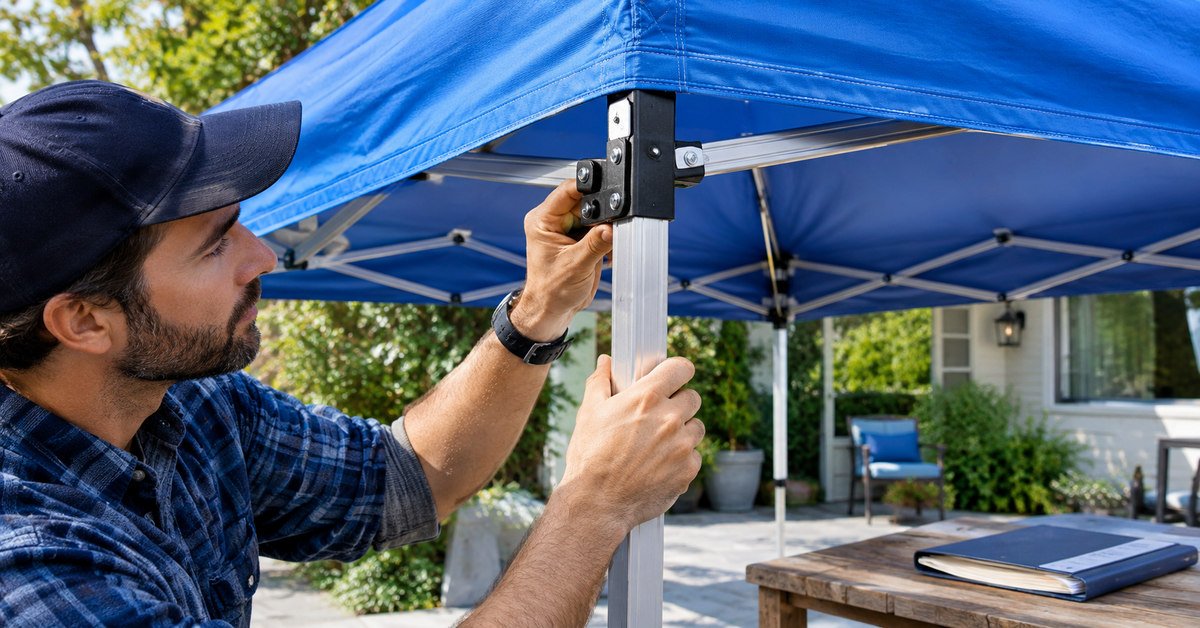
A canopy tent warranty normally covers manufacturing defects, but frame, fabric, and replacement terms may have different deadlines. ABCCANOPY’s general policy gives frames one year and tops six months. Eurmax assigns three months to fabric and bags, with longer frame periods varying by model. Weather damage and ordinary wear are usually excluded even when the advertised frame warranty is lengthy.
A clear warranty comparison starts with the exact model and purchase date, not a broad marketing slogan. Owners also need the seller’s authorization status and documentation showing which parts belong to the original package.
Coverage changes within a single manufacturer when a series uses different frame or roof materials. ABCCANOPY’s S3 BenchMark Brio Shield vinyl model lists seven years for its frame and three for its top. Compare model-specific documentation before applying a company’s general warranty to a specialized shelter.
This guide separates structural coverage, fabric protection, weather exclusions, and replacement eligibility. It also explains practical steps for documenting a defect before contacting support. Product examples illustrate why similar-looking shelters can carry different obligations.
Jump to a specific section on this article
Read Canopy Tent Warranty Terms Before You Buy
First determine whether the canopy tent warranty comes from the manufacturer, retailer, or another protection provider. Identify the exact model, eligible buyer, start date, and covered market. Check whether the original purchase must come from an authorized dealer. An otherwise valid defect claim can fail when these eligibility conditions are unmet.
Warranty language typically distinguishes defects in materials or workmanship from accidental damage. That distinction matters more than general claims about a frame being heavy duty. A bent leg caused by a collision is different from a weld separating during normal operation.
Review frame and fabric coverage independently before interpreting the advertised warranty length. Inspect separate terms for seams, sidewalls, printed panels, carrying bags, and attachment hardware. Custom artwork can have a distinct remedy from fabric construction defects.
During a broader canopy buying decision, compare written coverage alongside frame design and shelter dimensions. A warranty’s advertised period says little about which individual parts qualify. Some manufacturers supply an eligible spare part instead of an entire new shelter. Confirm whether claim evaluation requires photographs, inspection, or return authorization before shipping equipment.
Record the exact model identifier alongside the purchase date and authorized seller’s name. Keep the policy version supplied with the product, especially when a current website lists different coverage. If your canopy belongs to a special product series, confirm that series’ own terms.
Compare Canopy Frame Warranty Periods and Limits
The most useful frame comparison identifies both the covered component and the specific model series. Eurmax publishes frame terms from one to five years, depending on the purchased model. Mastertent gives Series 1 and Series 2 frames a limited lifetime warranty. ABCCANOPY’s S3 BenchMark Brio Shield vinyl series advertises seven years for the frame, unlike its general one-year policy.
A steel frame warranty may focus on welds, tubing, and joint workmanship. Aluminum frames can have different stated coverage without proving greater real-world strength. Compare the written exclusions before treating a longer period as superior protection.
Under the general ABCCANOPY warranty terms, standard frames receive one year and tops receive six months. For the ABCCANOPY 10×10 Commercial-Series Pop Up Canopy in White, confirm the governing policy using its model identifier. Specialized ABCCANOPY vinyl series can instead carry longer frame and roof periods. The exact product series, not the shared brand name, determines which written promise applies.
Consider how often the shelter folds, travels, and supports attached panels. A canopy size comparison helps establish the intended footprint but cannot establish warranty eligibility. Documented structural specifications and warranty obligations answer different questions.
Ask whether a cracked bracket qualifies for a single-part replacement. Also confirm whether obtaining that part changes the original coverage end date.
Check Canopy Fabric and Seam Warranty Coverage
Fabric coverage is commonly shorter than structural coverage, but specific brands use different periods. Eurmax publishes three months for fabric and roller bags. Mastertent specifies one year for roofs, sidewalls, printing, and many accessories under its published US warranty.
Read whether the fabric clause includes stitching, tape, coating, zippers, and printed artwork. A seam opening from defective sewing may support a different claim than a tear caused by abrasion. Photograph both sides of a failed seam before applying repair products. Keep the fabric dry and unfolded while collecting evidence when practical.
For the Eurmax USA 10×10 Commercial Pop Up Canopy with Four Zippered Walls in Kelly Green, roof and wall coverage need separate confirmation. Eurmax’s published three-month fabric term should not be confused with its model-dependent frame warranty. Check the product configuration when describing which failed component belongs to the set.
Color fading after sustained sunlight differs from coating delamination found during the warranty period. Manufacturers may exclude the first condition as wear while evaluating the second as a material defect. Water entering through defective factory seam tape warrants a different description than water pooling on a slack roof. Photograph the failure location before applying adhesive, seam sealer, or a patch.
Use differences between canopies and enclosed tents to clarify the shelter’s intended purpose before assessing fabric performance. That distinction keeps expectations about temporary shade separate from weatherproof camping protection.
Record the fabric’s purchase date before assuming a later frame deadline also protects the roof.
Identify Manufacturing Defects Covered by Canopy Warranties
A covered manufacturing defect concerns a faulty component under the conditions specified in the policy. Mastertent identifies potential examples including faulty connection pins, defective welds, and premature corrosion. Those categories do not mean every damaged pin or corroded tube receives approval. A claim still requires proof of the product, its use, and the observed failure.
On initial assembly, test that sliders and locking pins engage without forcing them. Check fabric panels for unfinished seams, misplaced attachment points, and missing components. Report defects found immediately because later use complicates evidence about their origin.
Separate an assembly problem from damage that developed after use. A joint that will not lock from the outset needs a different explanation than one crushed in transport. A labeled photograph can show the distinction without speculative diagnoses.
Knowing the main components of a canopy tent helps name the affected part accurately. Use consistent words for leg, truss, slider, roof peak, and connector. Precise identification reduces the chance of receiving an incompatible replacement.
Keep the failed part intact while the manufacturer decides whether physical inspection is required. Shipping damage should be reported through the relevant delivery procedure rather than treated automatically as manufacturing failure.
Describe observed symptoms clearly and let the warranty provider determine whether the condition is covered.
Understand Canopy Warranty Exclusions for Weather Damage
Wind, heavy rain, hail, and snow damage are excluded by several major canopy manufacturers. ABCCANOPY, Eurmax, and Mastertent expressly distinguish weather incidents from material and workmanship defects. A limited lifetime frame term does not convert storm damage into a covered manufacturing fault.
A roof can collect rainwater when tension or drainage becomes inadequate. Gusts can overload unsecured legs and joints even when the metal has no defect. Damage from these conditions is generally examined under use and weather exclusions. Remove temporary shelters when conditions exceed the manufacturer’s instructions instead of relying on warranty protection.
Owners should distinguish shelter safety guidance from the scope of a manufacturing warranty. Proper anchoring is necessary for responsible operation but cannot guarantee coverage after severe weather. Keep assembly instructions available whenever a different site or surface changes the setup.
Routine fading, wear from repeated folding, and mildew from wet storage may also fall outside coverage. Chemical damage and unauthorized alterations can produce additional exclusions. Read the exact policy rather than assuming all rain-related failures receive identical treatment. If there is a plausible manufacturing defect, explain the observed sequence without hiding weather conditions.
Vendors who use a 10×10 canopy at markets should document repeated setup conditions and storage practices. Commercial schedules can expose frames to handling that occasional backyard use never encounters. Ask specifically whether those operations meet the manufacturer’s definition of normal use.
Check Canopy Frame Rust and Joint Warranty Coverage
Rust requires careful classification because ordinary corrosion and premature manufacturing-related deterioration are different issues. Scratches and wet storage can expose a steel frame to accelerated surface rust. Mastertent separately lists premature corrosion among potentially covered defects for qualifying products.
Photograph the extent and location of corrosion before removing material with abrasive cleaning. Capture whether the affected area borders a factory weld, fastener, or chipped finish. Note the last cleaning method and the circumstances of storage. Those observations help the manufacturer distinguish corrosion causes without assuming the answer.
Aluminum frames do not develop red iron rust, although their fasteners and surfaces can still corrode. Mastertent’s Series 1 and Series 2 models advertise anti-corrosion protection alongside the limited lifetime frame warranty. Its US terms identify premature corrosion as a potentially covered defect.
Examine sliders, locking pins, bolts, and brackets individually when reporting a malfunction. A stuck slider could result from deformation, debris, or defective manufacture. Avoid forcing the mechanism because additional damage can obscure the original problem. Ask whether a factory joint defect is covered even when finish deterioration is excluded.
Identify whether the complaint concerns a coating, fastener, connector, or load-bearing tube. Different component types may qualify for different remedies. Surface marks alone should not be described as structural failure.
Review Replacement Canopy Roof and Parts Coverage
Replacement coverage does not necessarily entitle an owner to an entirely new canopy. Eurmax expressly limits its remedy to product or part replacement after reviewing the defect. E-Z UP allows repair or replacement at its discretion under published Canadian warranty terms.
A compatible replacement top needs more than the same nominal footprint. Peak profile, valance shape, attachment positions, and frame geometry determine whether fabric fits correctly. A part designed for a slant-leg canopy may not fit a straight-leg structure. Match the manufacturer’s model-specific replacement designation before approving installation.
With the Caravan Canopy V-Series PRO 2 10×10 in Camouflage, part compatibility depends on its straight-leg frame configuration. Caravan separately lists replacement tops for the V-Series 2 Pro and the slant-leg V-Series 2. Those are different part families even though both descriptions include ten-foot canopy sizing.
When a manufacturing defect qualifies, the provider may request photographs or a returned part before approving relief. ABCCANOPY’s policy directs owners to contact the manufacturer before shipping warranty components. Replacement authorization should specify the exact product and whether the defective component must be returned. A customer-ordering mistake is a separate issue from a covered manufacturing failure.
Store the approval email with the original policy and order confirmation. Recheck the finished repair for correct fit before the next event.
Check Canopy Roof Replacement Eligibility
Roof replacement claims should identify the defective textile component and its individual warranty deadline. Photograph the affected panel, seam, or attachment while the original configuration remains visible. Note whether the fabric was supplied with the complete shelter or purchased later. Request a replacement top designated for the exact model rather than an approximate size.
A replacement canopy purchased independently may carry different terms from the original bundled roof.
Replacing fabric with an unapproved third-party roof can jeopardize coverage where the policy explicitly excludes such accessories.
Ask whether a replacement is approved before discarding the defective top. Confirm that the color and attachment format match the documented order. Keep the replacement approval and delivery record together for future reference.
Verify Canopy Frame Parts and Replacement Terms
Frame part claims are easier when the manufacturer receives precise component names. Identify the leg section, slider, truss, connector, or locking pin that failed. Photograph the component beside the full frame to establish its position. Match the model label to a spare-parts diagram whenever one is available.
Individual parts can differ even when two shelters share the same footprint. A slightly different joint geometry can prevent safe assembly. Manufacturer part diagrams or support confirmation are preferable to visual guessing.
Ask whether the replacement part is supplied under the original frame warranty. Confirm any return requirement and whether shipping instructions depend on component size. Do not drill, cut, or alter components while eligibility remains under review. Use only a documented compatible component when returning the frame to service.
Keep the removed part until support says it can be discarded. Inspect the installed replacement for smooth movement and proper locking. If the new component fails, reference the earlier claim record when contacting support.
Prepare Evidence for a Canopy Tent Warranty Claim
Start a canopy tent warranty claim with a dated receipt and the precise frame model. Capture one full-shelter photograph, followed by close views of the damaged joint or fabric. Include the date of discovery and a factual account of the failure.
ABCCANOPY expressly requests proof of purchase and photographs of the damaged item. Eurmax asks for the order reference, a picture, and a brief defect description. Photograph the product label and any relevant part number so support can identify the correct configuration. Keep image originals rather than screenshots compressed through messaging apps.
| Issue to document | Evidence worth collecting | Warranty question and next step |
|---|---|---|
| Roof seam opens | Wide roof photo, close-up of the original stitching, and the roof’s attachment position. | Ask whether the failure is defective stitching under the fabric warranty before applying a patch. |
| Frame pin or slider will not lock | Model label, a short operation video, and clear photographs of the affected joint. | Ask whether the locking component qualifies for a covered frame-part repair or replacement. |
| Weld or tube cracks | Full-frame view, close-ups showing the fracture, and any relevant impact history. | Request a workmanship review and accurately describe the circumstances of the failure. |
| Corrosion develops near a joint | Photographs of affected metal, surrounding coating, and details of cleaning and storage. | Check whether the policy distinguishes premature corrosion from ordinary wear or exposure. |
| Leg bends during strong wind | Photos of the bend, anchoring arrangement, and the conditions when damage occurred. | Review weather exclusions and report the incident without assuming a manufacturing defect. |
| Replacement roof does not fit | Original frame model, replacement part number, and photos of the roof attachment points. | Verify approved part compatibility before altering straps, hardware, or fabric. |
Describe frequency of use, assembly steps, and storage conditions in factual terms. Explain any previous repairs and identify whether authorized parts were used. Avoid guessing that an observed fracture proves a particular manufacturing process failed.
Follow the warranty instructions associated with the purchase region and the exact model. Eurmax publishes a service email for claims, while ABCCANOPY directs customers to contact its warranty department. Do not ship bulky frame components before support supplies return instructions.
Do not discard a defective part until the manufacturer confirms its disposition. Following the documented claim process protects evidence while support evaluates eligibility.
Understand Canopy Warranty Repair and Shipping Costs
Shipping responsibility is a practical part of a canopy tent warranty claim. ABCCANOPY distinguishes products damaged on arrival from covered defects discovered during use. Its general policy states that eligible arrival damage reported within three days receives return shipping coverage. For covered damage arising during use, the customer handles shipping while replacement parts and labor are supplied without an additional charge.
The warranty may permit repair instead of an identical full-unit replacement. Ask whether labor, packaging, and disassembly fall within the promised remedy. These details can matter when a heavy commercial frame needs transport.
ABCCANOPY’s three-day arrival-damage reporting window makes early inspection particularly important. Eurmax asks claimants to send a photo, order information, and defect description for review. E-Z UP’s Canadian warranty assigns customers the shipping costs of returning items for consideration. These procedures differ by brand and region, so a general shipping assumption is unreliable.
Obtain a return authorization before shipping components when the policy requires one. Use packaging that protects joints and edges from damage in transit. Keep the carrier receipt and photograph the prepared parcel.
If a replacement is unavailable, request the permitted alternative in writing. Compare the exact part description to your original equipment before accepting it. Preserve the decision record in case the replacement later develops another problem.
Compare Canopy Tent Warranty Support Across Brands
Manufacturer warranty periods make sense only when each comparison identifies the product line. ABCCANOPY’s general frame and top periods are one year and six months. Its S3 BenchMark Brio Shield vinyl line lists seven years for its frame and three for its top. Eurmax advertises frame terms of one to five years by model and three months for fabric and bags.
Mastertent provides limited lifetime coverage for Series 1 and Series 2 frames, plus one year for several fabric components. The word lifetime refers to a limited warranty obligation, not an independently measured service life. Compare defined remedies, exclusions, and the availability of parts alongside the stated duration.
Eurmax directs warranty claimants to submit photographs, order information, and a concise defect description by email. ABCCANOPY requires proof of purchase and photographs before reviewing a claim. Mastertent also advertises ongoing spare-parts support for qualifying professional structures.
For professional events, ask whether the model’s warranty expressly includes recurring commercial use. Rental operations may involve different handling and ownership requirements than a business using its own shelter. Save the response that names the model and the intended use.
When a canopy fails, first identify the part and locate the applicable policy date. Next compare the observed defect with exclusions for weather, misuse, and ordinary wear. Check whether the brand supplies an approved replacement part for that frame. Submit evidence before attempting a repair that could alter the failure.
A practical warranty choice is the policy that clearly covers your equipment, usage, and likely service needs.
Frequently Asked Questions about Canopy Tent Warranty
How long is a typical canopy tent manufacturer’s warranty?
Canopy tent warranties commonly give fabric less coverage than the original frame. ABCCANOPY’s general policy specifies one year for its frame and six months for fabric. Eurmax publishes one to five years for frames, depending on the model. Its fabric and roller bag coverage lasts three months.
These general terms do not describe every canopy from the same manufacturer. Mastertent covers Series 1 and Series 2 frames under limited lifetime terms. Its published US warranty gives roofs, sidewalls, and many accessories one year.
Read the current policy associated with the model, not a seller’s general summary. Look for separately named components and the claim deadline for each. Warranty duration describes potential defect coverage, not how long the canopy will physically last.
Does a canopy tent warranty start at purchase or delivery?
Many canopy warranty clocks begin on the original purchase date shown on the receipt. ABCCANOPY and Eurmax use purchase-based timing in their published general policies. The Canadian E-Z UP warranty uses the purchase date or a later delivery date. That Canadian condition cannot establish the deadline for a US purchase. Retain both documents when your delivery arrives substantially after ordering.
Are canopy tent warranties transferable to another owner?
Many limited warranties protect only the original purchaser and cannot transfer automatically. E-Z UP’s published Canadian policy expressly restricts coverage to the original end-user buyer. Someone acquiring a used shelter should verify the actual model and sales region. An unexpired warranty term alone does not establish transfer rights.
Keep the original receipt if you plan to pass the canopy to someone else. A sales receipt alone does not establish a new owner’s eligibility. The manufacturer can clarify whether any separate parts support remains available.
Can secondhand canopy tents qualify for warranty coverage?
Secondhand canopies often fall outside warranties restricted to the original end-user purchaser. Eligibility also may depend on buying through an authorized seller. E-Z UP’s published policy restricts both transferability and some unauthorized purchases. Check the individual policy rather than assuming remaining years follow the equipment.
Ask the seller for the model label and original receipt. Verify whether the manufacturer accepts a changed owner or replacement proof. If coverage is unavailable, investigate compatible parts before acquiring a damaged frame.
Inspect locking mechanisms and roof attachment points carefully during a secondhand purchase. Document existing defects with clear photographs before transporting the shelter. A repairable component can still be impractical when its exact replacement is discontinued.
Does replacing a canopy roof void the original warranty?
Replacing a canopy roof does not automatically void every part of its original warranty. What matters is compatibility, authorization, and whether the replacement contributed to damage. ABCCANOPY specifically excludes damage caused by unapproved third-party tops and accessories. Use the manufacturer’s correct roof designation rather than relying solely on a matching footprint. Keep written permission before modifying straps, corners, or frame attachments.
The replacement fabric may have its own coverage period or only the original remaining term. The manufacturer must confirm which rule applies to your product. Save the approval message alongside the original warranty.
Are canopy tent warranties valid for commercial or rental use?
Commercial ownership and rental use deserve separate checks against the canopy’s written warranty. Mastertent explicitly markets Series 1 and Series 2 as professional event equipment. That positioning does not establish automatic coverage for every rental arrangement or weather incident. Ask the provider whether the planned use meets its eligibility conditions.
Ask whether regular assembly by hired crews affects covered use. Check if printed roofs, vendor attachments, or replacement walls receive separate treatment. Keep written responses identifying the precise model and usage pattern.
Repeated setup increases opportunities for transport damage and misplaced components. Store assembly instructions and label each part before returning equipment to storage. Document inspections between events when a future failure may need explanation.
Obtain written approval for the intended commercial use before relying on warranty coverage.
Does a canopy tent warranty cover stakes and carrying bags?
Accessory coverage is not necessarily the same for every item packed with a canopy. Eurmax gives roller bags the same three-month term as fabric under its general policy. ABCCANOPY identifies walls, roller bags, and rain gutters among items with six-month coverage. Check stakes and ropes individually because these are not expressly listed in every accessory clause.
How long does a canopy tent warranty claim usually take?
A manufacturer may not publish a fixed number of days for canopy warranty decisions. Timing depends on identifying the correct part, reviewing evidence, and arranging inspection or shipment. Submit the receipt, model label, and close photographs together to prevent avoidable follow-up requests. Ask support for an acknowledgement and a specific next-update date.
A claim that requires returning a frame component can take additional shipping time. Keep all correspondence and follow the stated return instructions. Confirm that an approved replacement matches the exact frame or fabric variant.
Can buyers claim a canopy warranty without registering it?
ABCCANOPY’s published claim instructions request proof of purchase and photographs without listing registration as a required step. That example does not establish another brand’s registration policy. Some models include registration cards even when the governing warranty emphasizes purchase documents. Check the actual wording before assuming an unregistered product is ineligible.
Keep a dated receipt and order details even when registration is optional. Record the serial or model label before repeated outdoor use damages it. Manufacturer support may ask for both the seller identity and original purchase date.
If you missed a registration deadline, contact the provider with the available documentation. Ask whether the policy offers another way to establish eligibility. Avoid asserting a right to coverage until the applicable terms have been checked.
Does a canopy tent warranty apply to purchases made overseas?
International warranty eligibility depends on the product’s sales region and the manufacturer policy. A model sold under the same name may have different support arrangements across countries. Shipping a damaged frame across borders may require separate authorization and documentation. Confirm the destination support office before making an overseas purchase.
Check whether the selling business is an authorized dealer in that market. Ask which country will handle claims, inspections, and replacement shipments. Keep invoices showing the original transaction and delivery location.
Regional consumer rights may exist independently of a manufacturer’s limited warranty. The manufacturer’s terms and applicable local law should be considered separately. Written regional confirmation is more useful than assumptions based on a foreign website.
Request the governing warranty document for the intended delivery country before ordering.
Ready to Explore Your Canopy Tent Warranty?
A canopy tent warranty usually covers eligible manufacturing defects, with separate periods for frame, fabric, and replacement components. General ABCCANOPY terms are one year for frames and six months for tops. Eurmax lists model-dependent frame periods and three months for fabric, while Mastertent names different professional-series terms.
If your canopy has failed, locate its model label and original receipt first. Photograph the exact damage, preserve the affected part, and contact the authorized warranty channel. Request written confirmation of replacement compatibility and shipping responsibilities before making repairs.